



GOVERNANCE & BUSINESS MATERIAL TOPICS

Good Corporate Governance

Business Growth
Innovation Promotion
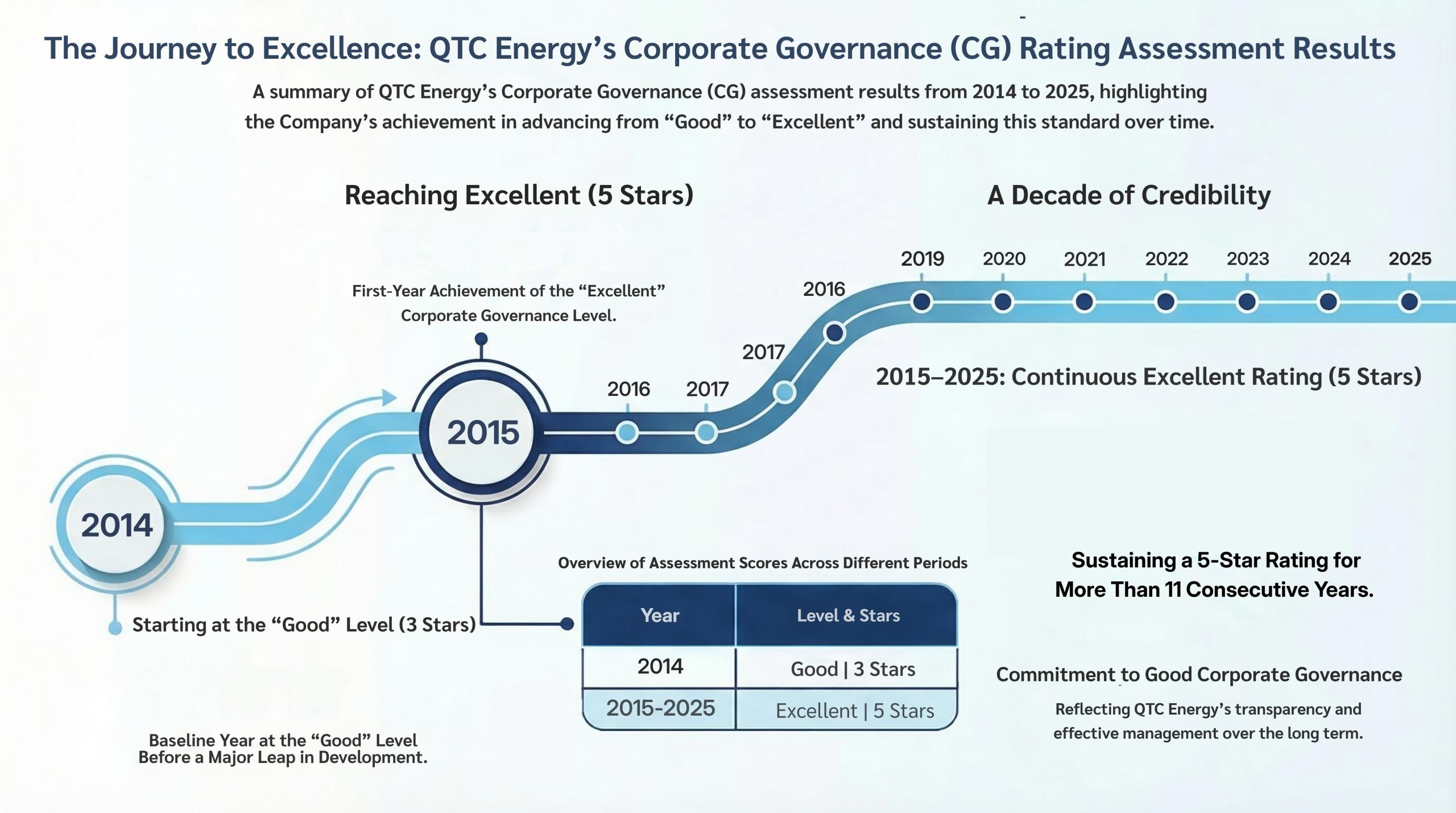
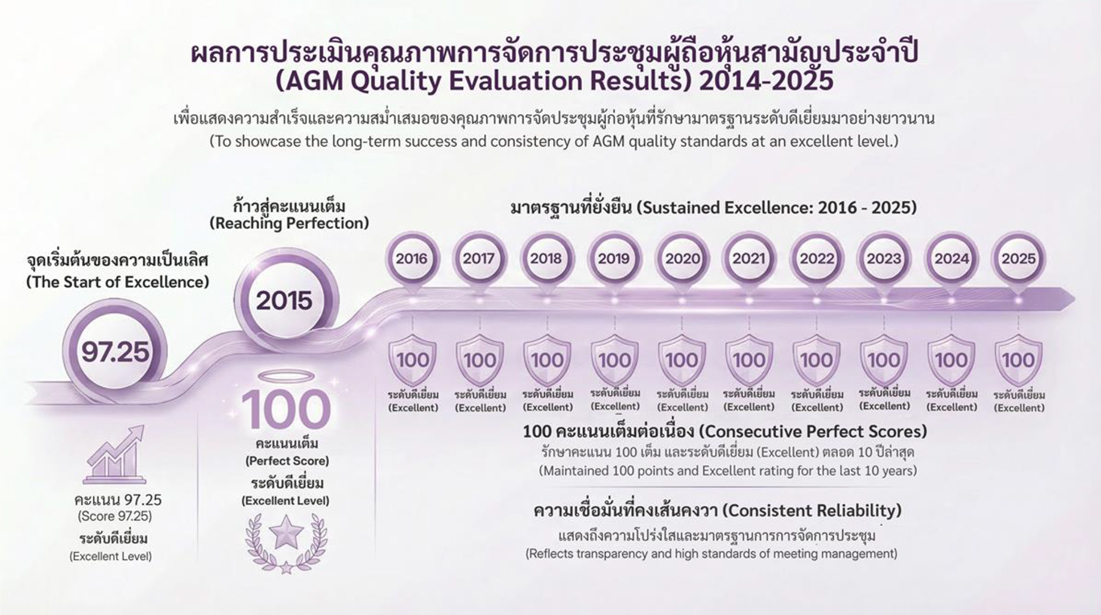
QTC conducts its business under the principles of good corporate governance alongside the creation of sustainable economic value, adhering to transparency, accountability, and ethical business practices. The company focuses on efficient resource management, promotes fair competition, and builds trust among all stakeholder groups.


QTC Energy Public Company Limited places importance on good corporate governance as a fundamental foundation for sustainable business operations, adhering to the principles of good governance, transparency, ethics, and responsibility toward all stakeholder groups, together with strict compliance with applicable laws and regulations. This approach contributes to strengthening confidence among shareholders, investors, employees, business partners, and customers, while helping reduce legal, reputational, and operational risks, in alignment with SDG 16: Peace, Justice and Strong Institutions.
The Company has developed a corporate governance system covering Board oversight, enterprise risk management in accordance with internationally recognized frameworks, internal control systems, anti-corruption measures, personal data protection, as well as transparent and verifiable disclosure. This is to ensure efficient and fair operations aligned with the expectations of all stakeholder groups, supporting the creation of a responsible and sustainable business environment, in alignment with SDG 8: Decent Work and Economic Growth.
Risk, Opportunity, and Impact Assessment

QTC Energy Public Company Limited aims to expand its business alongside risk management amid the volatility of the economy, technology, and increasingly stringent ESG regulations. The company emphasizes efficient resource utilization and the creation of shared value with stakeholders throughout the value chain, while supporting the development of stable and sustainable energy infrastructure. This approach is aligned with SDG 7 and SDG 9 to promote clean energy and sustainable innovation without causing negative impacts on society and the environment.
The company is committed to high-quality growth by enhancing competitiveness, financial stability, and organizational capabilities through investments in technology, personnel development, and responsible business practices, supporting SDG 8 on employment and economic growth. In this regard, “business growth” is considered a key sustainability issue, covering both Impact Materiality on stakeholders and the ability to create long-term value (Financial Materiality), in order to achieve a balance between business performance, society, and the environment.

Risk, Opportunity, and Impact Assessment
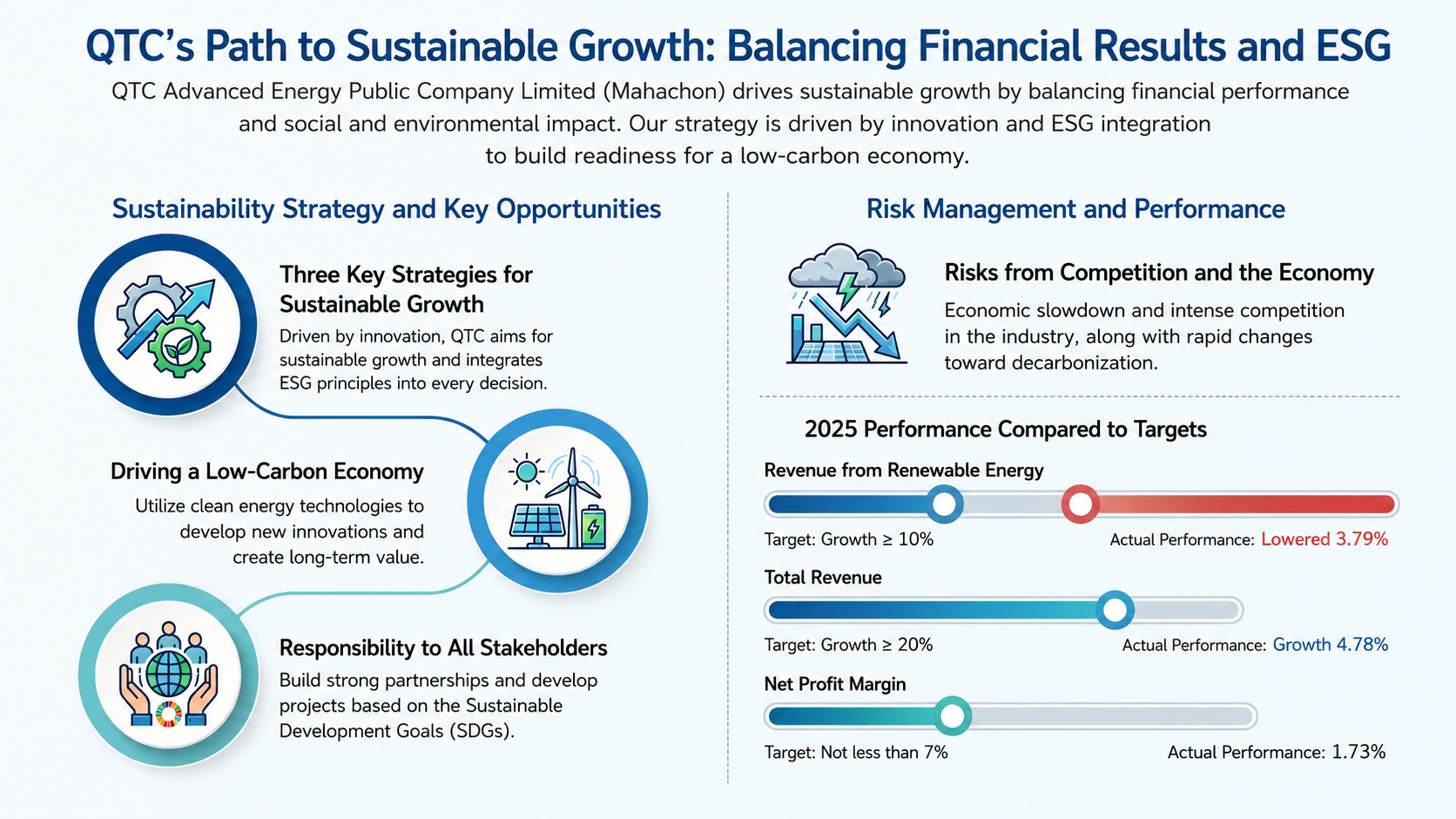
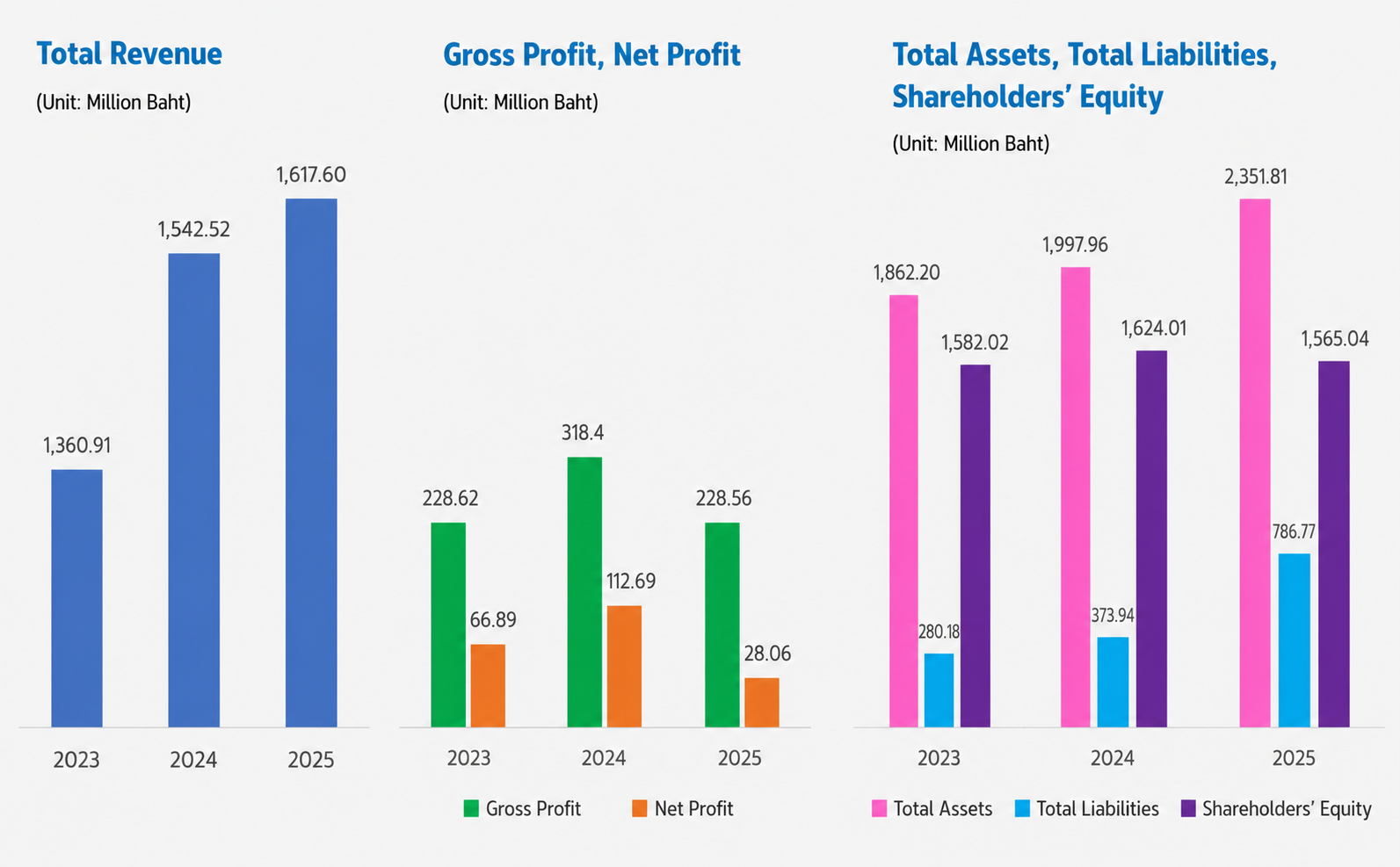
Economic Performance
| Financial | 2566 | 2567 | 2568 |
|---|---|---|---|
| Revenue from Sales and Services | 1,337.12 | 1,515.44 | 1,584.56 |
| Total Revenue | 1,360.91 | 1,542.52 | 1,617.60 |
| Cost of Sales and Services | (1,108.49) | (1,197.05) | (1,356.00) |
| Gross Profit | 228.62 | 318.4 | 228.56 |
| Selling and Service Expenses | (167.12) | (199.89) | (215.97) |
| Profit Before Interest and Income Tax | 84.38 | 144.48 | 45.65 |
| Net Profit | 66.89 | 112.69 | 28.06 |
| Total Comprehensive Income for the Year | 66.89 | 108.11 | 21.37 |
| Earnings per Share | 0.196 | 0.332 | 0.085 |
| Dividend per Share | 0.20 | 0.25 | 0.20* |
| (341,092,557.00) | (341,092,557.00) | (341,092,557.00) | |
| Total Assets | 1,862.20 | 1,997.96 | 2,351.81 |
| Total Liabilities | 280.18 | 373.94 | 786.77 |
| Shareholders’ Equity | 1,582.02 | 1,624.01 | 1,565.04 |
การดำเนินงานที่สำคัญ
Value Distribution to Stakeholders
| Item | QTC Energy | QTCGP, Q Solar 1, QTC RE , QTC EV , QTC ESS |
| Value Distribution to Shareholders | (บาท) | |
| Dividends Paid to Shareholders | 85,148,164.25 | |
| Dividend per Share | 0.25 | |
| Investment in Human Capital | ||
| Employees | 150,850,012.00 | |
| Executive Directors, Managing Directors of Subsidiaries, and Company Directors (Executive Directors) | 40,944,833.00 | |
| Board of Directors (Non-Executive Directors) | 10,080,000.00 | |
| Investment in Society | ||
| Donations and Sponsorships | 1,193,515.82 | 312,090.53 |
| Support for Social Enterprises : SE (Indirect) | 0.00 | 0.00 |
| Expenditures on Community and Environmental Engagement Activities | 211,741.71 | 12,000.00 |
| Support for Dual Vocational Education and Cooperative Education Programs for Workforce Development | 2,564,658.00 | |
| Support for the Promotion and Improvement of Quality of Life for Persons with Disabilities | 481,880.00 | 0.00 |
| Investment in the Environment | ||
| Internal Environmental Management Expenses | 489,925.00 | 115,450.00 |
| Waste Management and Other Related Expenses | 316,404.00 | 0.00 |
| Distribution to Business Partners | ||
| Domestic Procurement (Raw Materials) | 694,271,292.22 | 243,517,962.13 |
| Overseas Procurement (Raw Materials) | 200,781,472.39 | 131,685,863.83 |
| Procurement of Equipment and Power Plant Maintenance Services (Domestic) | 0.00 | 75,217,008.05 |
| Procurement of Products from Persons with Disabilities | 118,500.00 | 0.00 |
| Other Economic Value | ||
| Finance Costs (Interest Expenses) | 3,389,563.27 | 1,805,703.44 |
| Tax Obligations Payable to the Government from 2025 Operating Results ** | 6,156,345.94 | 7,783,471.18 |
Tax Transparency
QTC Energy Public Company Limited and its subsidiaries adhere to tax management under the principles of good corporate governance, accuracy, transparency, and strict compliance with applicable laws and regulations. The Group has established a Tax Policy as a governance framework for tax management and appropriate tax planning.
The objective of this approach is to strengthen corporate responsibility, reduce legal, regulatory, and governance risks that may affect the financial stability and reputation of the organization, and build confidence among all stakeholder groups, including shareholders, regulatory authorities, business partners, and society as a whole. This reflects the Company’s role in supporting economic stability and the long-term sustainable development of the country.


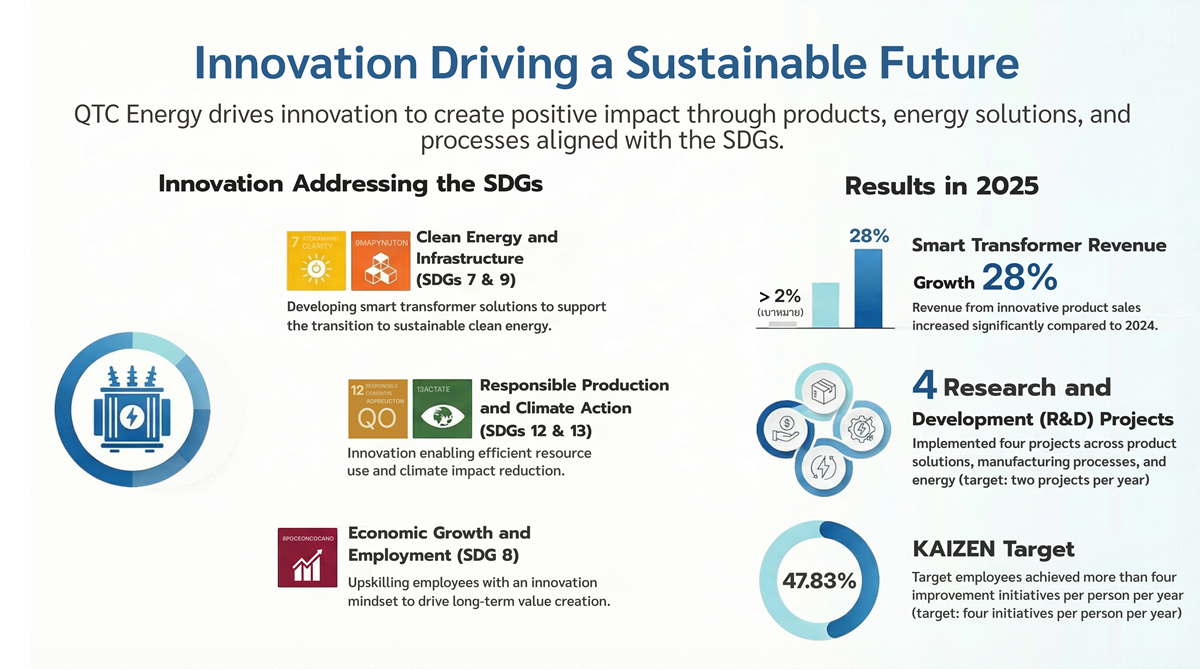
Innovation promotion is an important mechanism for driving the sustainable growth of QTC Energy Public Company Limited. It is material in both the dimensions of impacts on the business (Financial Materiality) and impacts on the economy, society, and the environment (Impact Materiality). This reflects both the Company’s ability to create value and maintain long-term competitiveness, while generating positive impacts on the economy, society, and the environment.
The Company develops innovations in products, energy solutions, and work processes to enhance efficiency, support the transition to clean energy, and strengthen energy security. These efforts are aligned with Sustainable Development Goal (SDG) 7: Affordable and Clean Energy, SDG 9: Industry, Innovation and Infrastructure, and SDG 8: Decent Work and Economic Growth. At the same time, innovation serves as an important tool for improving resource efficiency, reducing waste, and lowering greenhouse gas emissions throughout the value chain, thereby supporting responsible consumption and production (SDG 12) and climate action (SDG 13). Innovation promotion therefore serves as a foundation for risk management, long-term value creation, and sustainable development, while aligning with stakeholder expectations and changes within the energy industry.
Risk, Opportunity, and Impact Assessment
Innovation Promotion Process within the Organization
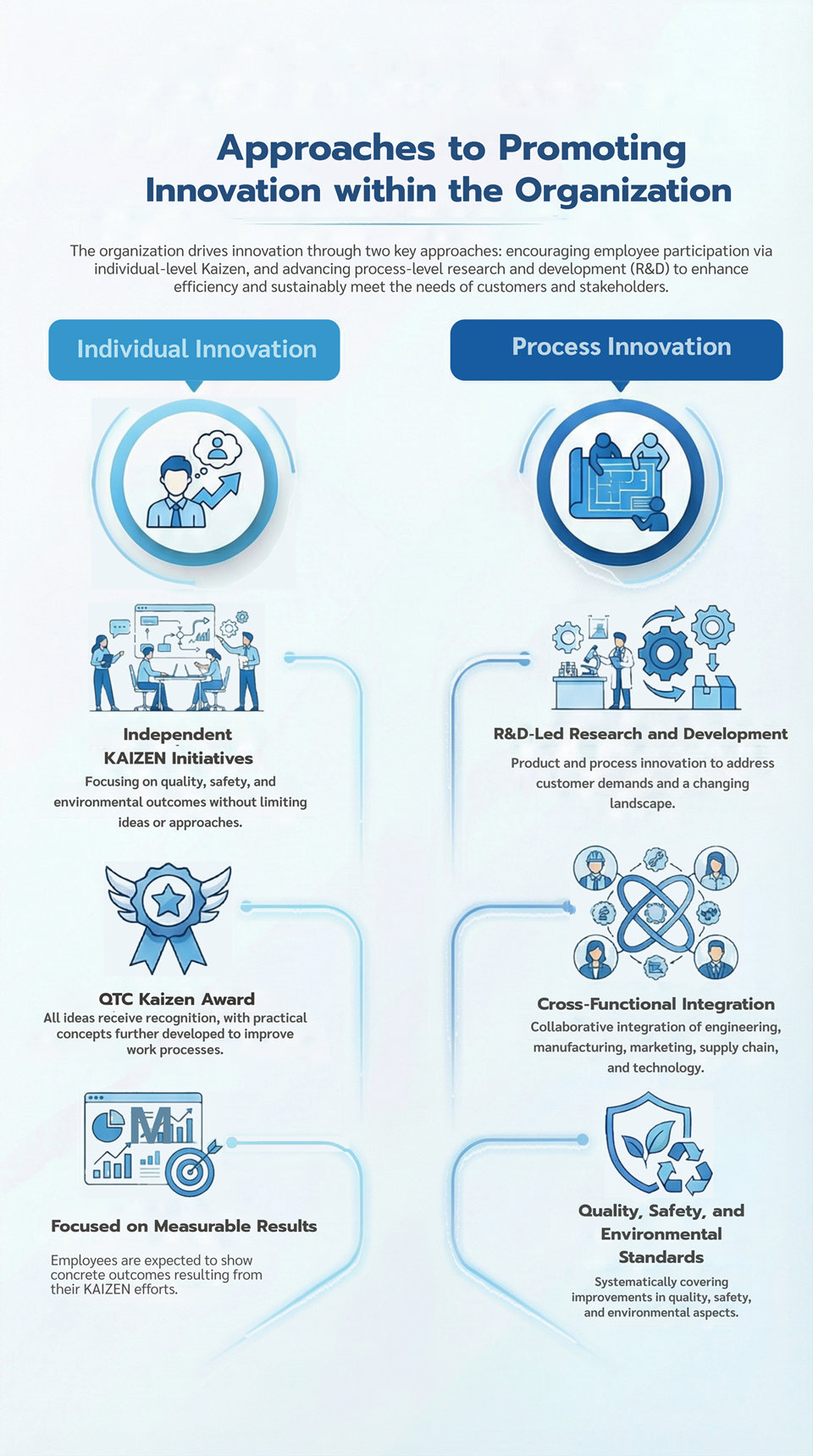
Individual-Level Innovation Promotion
QTC Energy Public Company Limited places importance on fostering innovation from within the organization, particularly by encouraging individual employees to participate in the continuous improvement of work processes through the systematic application of KAIZEN principles. The Company has continuously promoted such activities since 2013 and has refined its approach to align with changing business contexts. Employees are encouraged to begin by improving tasks within their own responsibilities, where they possess the deepest understanding, leading to the development of practical solutions that generate tangible results.
Process Innovation Promotion
The Company places importance on promoting process innovation as a policy mechanism that supports long-term competitiveness while creating sustainable value for the economy, society, and the environment. Such innovation focuses on enhancing operational efficiency, optimizing resource utilization, and reducing environmental impacts in order to respond to the evolving expectations of customers, business partners, and all stakeholder groups. The Company’s consideration and advancement of process innovation are based on the assessment of risks and opportunities arising from both internal and external factors that are rapidly changing and may affect business continuity and long-term sustainability. The Company has identified three key areas of change that are material to innovation development within the organization