
Social Commitment
QTC Energy Public Company Limited is committed to conducting its business with responsibility toward all stakeholder groups, placing importance on customer responsibility through the development of quality products and services that meet standards and safety requirements, as well as continuous customer care. The company manages its suppliers under principles of transparency, accountability, and fair competition, while promoting suppliers to operate in accordance with sustainability practices. At the same time, the company places the highest priority on employee safety, occupational health, and well-being by establishing preventive measures and systematic risk management to create a safe working environment that supports effective operations. In addition, the company operates under fair labor standards, emphasizing human capital development, enhancing employees’ skills, knowledge, and capabilities, along with comprehensive care for employees’ quality of life and well-being. The company is also committed to respecting human rights both within the organization and throughout the value chain, with appropriate communication, awareness building, and human rights due diligence processes. Recognizing its role as part of society, the company supports and develops communities through activities and projects aimed at improving quality of life, creating educational opportunities, and supporting vulnerable groups, in order to achieve balanced and sustainable growth for both the organization and society.

Amid changes in the business environment, the company places importance on supplier management and procurement with transparency, accountability, and efficiency. The focus is on the selection and development of suppliers, particularly local enterprises, to enhance cost management flexibility, reduce supply chain risks, and support business continuity. In addition, the company manages suppliers under principles of good governance, emphasizing assessments of quality, labor, human rights, anti-corruption, and environmental management, in order to support responsible business operations aligned with Sustainable Development Goals SDG 8, SDG 9, and SDG 12.

Risk, Opportunity, and Impact Assessment
Risk
If suppliers fail to comply with quality standards, business ethics, labor laws, human rights requirements, or environmental management practices, it may affect operational continuity, product quality, and the Company’s reputation. At the same time, cost fluctuations, exchange rate changes, and uncertainties relating to overseas suppliers may increase procurement costs and affect long-term operating performance.
Opportunity
Enhancing supplier management in a systematic manner and appropriately diversifying procurement sources from both domestic and international suppliers help improve cost management flexibility, reduce dependence on a single supplier group, and strengthen the Company’s competitiveness. This approach also helps enhance the confidence of customers and stakeholders and supports sustainable long-term growth.
Financial materiality
+ Supports business continuity and long-term competitiveness.
+ Appropriate diversification of procurement sources from both domestic and international suppliers enhances cost management flexibility, reduces dependence on a single supplier group, and supports long-term business stability.
– Reputational risks and loss of customer confidence, which may result in order cancellations or trade restrictions.
– Additional costs may arise from auditing, monitoring, and addressing supplier non-compliance issues.
– Cost fluctuations, exchange rate changes, and uncertainties relating to overseas suppliers may increase procurement costs or affect operational continuity, which may impact the Company’s cost management capability and operating performance.
Impact materiality
+ Encouraging suppliers to comply with labor, human rights, and environmental codes of conduct helps raise operational standards throughout the value chain.
+ Procurement management that prioritizes domestic enterprises supports the domestic economy, creates business and employment opportunities, and strengthens the supply chain, which is aligned with the sustainable development of society as a whole.
– If suppliers neglect labor, human rights, or environmental management issues, negative impacts may occur to employees, communities, and local ecosystems.
– Risks associated with the Company’s linkage to inappropriate actions by suppliers, which may affect trust among society and stakeholders.
– Excessive dependence on a particular procurement source, or the absence of systematic procurement management, may reduce economic opportunities for domestic enterprises and increase risks relating to fairness, transparency, and confidence among suppliers and stakeholders throughout the supply chain in the long term.
Strategy :
- Responsible supplier selection and oversight
- Supply chain risk monitoring and management
- Supplier development and sustainable collaboration
Management Approach :
Procurement policy implementation; establishment of the QTC Supplier Code of Conduct covering business ethics, human rights, labor rights, occupational safety, and anti-corruption; communication and assessment of supplier capabilities against the prescribed code of conduct; supplier registration; development plans for Tier 1 SME suppliers; management under the ISO 9001 standard system; and Human Rights Due Diligence (HRDD).
Target 1 :
Percentage of procured raw materials that passed acceptance inspection in accordance with the specified quality standards of not less than 95%
Performance :
In 2025, 99.50% passed acceptance inspection in accordance with the specified quality standards. Target achieved.
Target 2 :
Percentage of raw materials delivered by suppliers in accordance with the agreed schedule of not less than 95%
Performance :
In 2025, 99.69% of raw materials were delivered in accordance with the agreed schedule. Target achieved.
Target 3 :
Percentage of suppliers in all groups that received communication and guidance on the QTC Supplier Code of Conduct, 100%
Performance :
In 2025, 100% of suppliers received communication and confirmed their understanding. Target achieved.
Target 4 :
Number of Tier 1 SME suppliers developed and enhanced in accordance with the established plan of not less than 3 suppliers per year
Performance :
In 2025, 1 Tier 1 SME supplier was developed. Target not achieved.
Target 5 :
Number of confirmed complaints or human rights violation cases involving Tier 1 suppliers = 0 cases (complaints or human rights violation cases related to the operations of Tier 1 suppliers that have been verified as having occurred through the Company’s Human Rights Due Diligence (HRDD) process)
Performance :
In 2025, there were no confirmed human rights complaints involving Tier 1 suppliers. Target achieved.
However, human rights risk issues were identified among construction contractor suppliers. The Company followed up closely in accordance with the established procedures. Further details are provided under “Human Rights”.
Target 6 :
Percentage of key raw material categories with 3 or more suppliers per raw material category, 100%
Performance :
In 2025, 80% of key raw material categories had 3 or more suppliers per raw material category.
Supplier Management Approach
The Company places importance on systematic supplier management to ensure that procurement and operations throughout the supply chain are transparent, fair, and traceable. The Company has established a Procurement Policy and the QTC Supplier Code of Conduct as the framework for engagement with all supplier groups, together with a clear and standardized supplier evaluation and selection process. Such evaluation covers organizational management capability in accordance with international standards, including ISO 9001, ISO 14001, and ISO 45001, performance and service quality during the previous year, as well as the ability to respond to the Company’s requirements. In addition, the Company places importance on compliance with the QTC Supplier Code of Conduct, which covers legal compliance, anti-corruption, fair labor practices, safety, and environmental responsibility. Significant Tier 1 suppliers are required to undergo Human Rights Due Diligence (HRDD) risk assessments in all cases to support ethical and sustainable business operations and the creation of shared value in the long term.
Procurement of Goods and Services
The Company places importance on the systematic, transparent, and traceable management of the procurement of goods and services, covering procurement from both domestic and international suppliers. The Company continuously monitors procurement value and procurement proportions to support appropriate supply chain planning and management. This procurement approach supports sustainable business operations through the promotion of domestic enterprises alongside responsible resource management, in line with SDG 8: Decent Work and Economic Growth and SDG 12: Responsible Consumption and Production.


The company is committed to occupational health, safety, and workplace well-being through management in accordance with standards, the use of appropriate technology, and continuous personnel development to prevent accidents, injuries, and work-related illnesses. It establishes policies and practices covering employees, contractors, and stakeholders, while implementing systematic risk management to create a safe and sustainable working environment, in alignment with SDG 3 and SDG 8.
Risk, Opportunity, and Impact Assessment
Risk
If occupational health and safety management is not effective, it may result in accidents, injuries, or work-related illnesses, affecting employee safety, morale, and work efficiency, and may also lead to cost impacts, business disruptions, and the organization’s reputation and credibility in the long term.
Opportunity
Enhancing occupational health and safety management in a systematic manner helps reduce workplace accidents and illnesses, promotes employee efficiency and engagement, strengthens the image of a socially responsible organization, and supports sustainable business growth in the long term.
Financial materiality
+ Strengthen the organization’s image and credibility, supporting competitiveness and sustainable growth
– Serious accidents or non-compliance with safety standards may result in financial costs, legal risks, and damage to the organization’s reputation
Impact materiality
+ A working environment that supports dignified work and a good quality of life is established
+ A sustainable safety culture is established
– Inadequate safety management may lead to violations of employees’ rights to work safely and may adversely affect physical and mental health
– Workplace accidents or illnesses may undermine employee morale, employee engagement, and stakeholder confidence
Strategy :
- Strengthen preventive safety management systems
- Reduce health and workplace environmental risks
- Strengthen a safety culture through employee awareness and behavior
Management Approach :
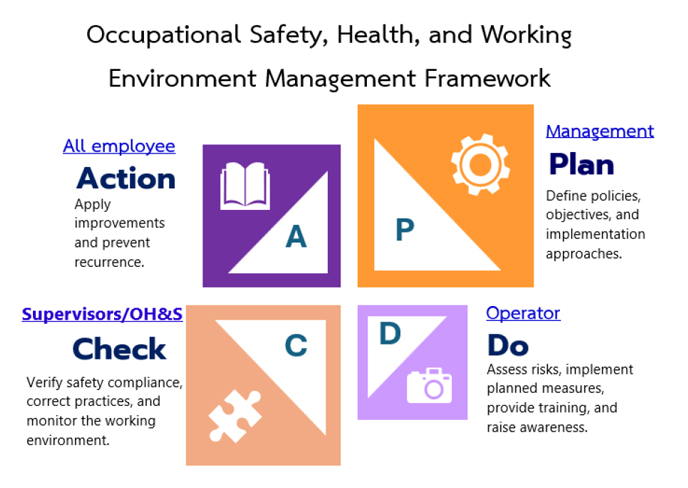
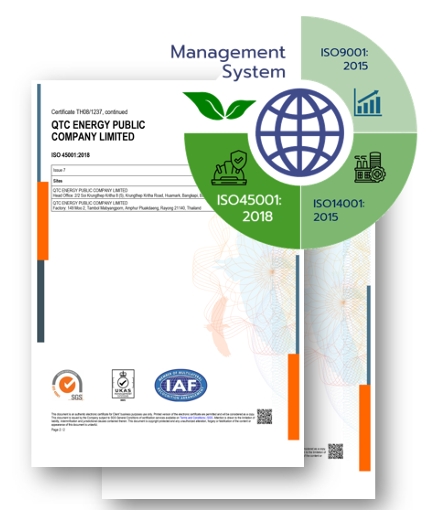
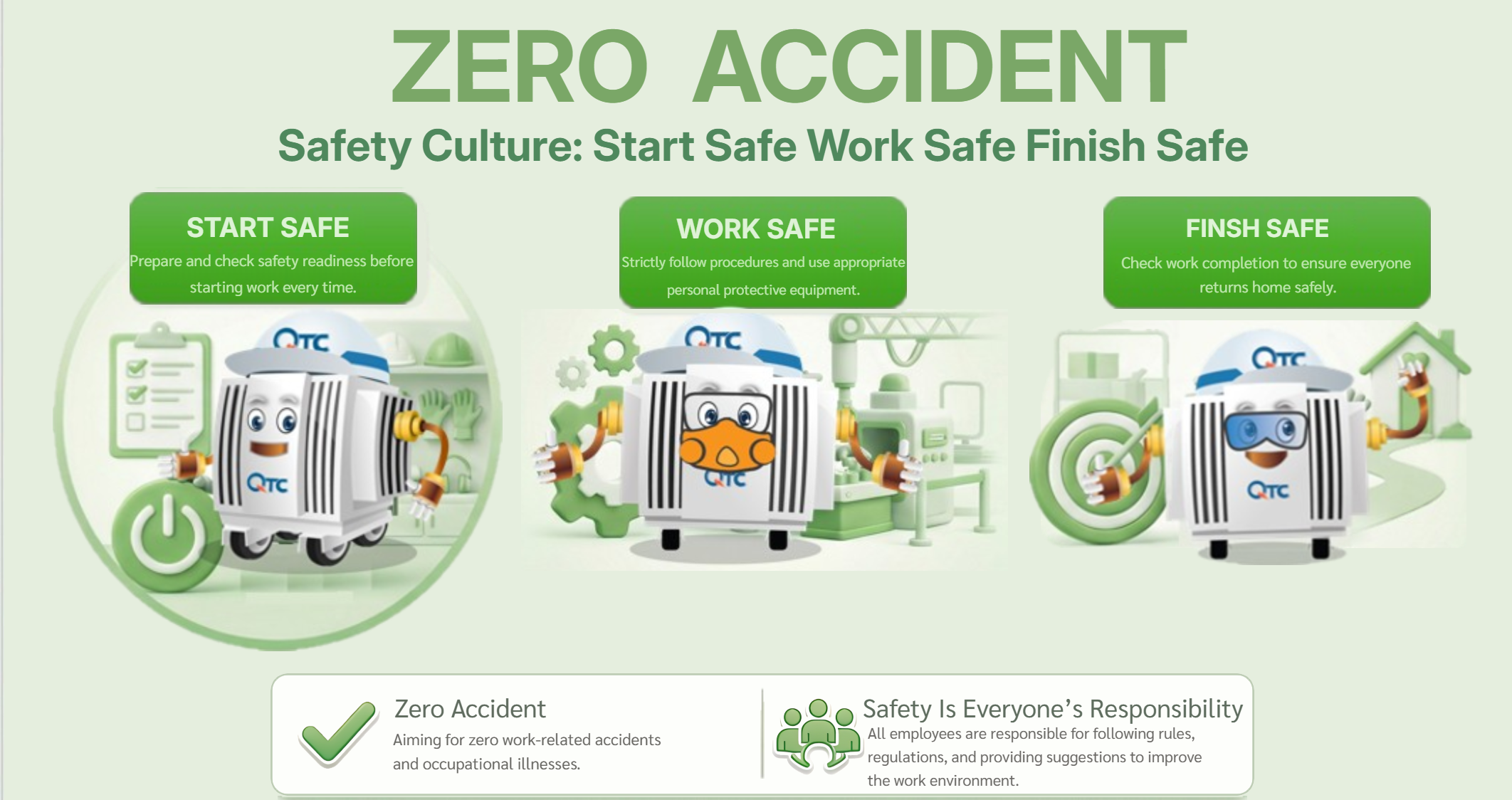
The Company adopts the ISO 45001:2018 management system as the operational framework, together with clearly defined safety policies and targets to guide employees at all levels. The Company also promotes its Moral Health Organization Policy to enhance employees’ quality of life, physical health, and mental well-being, and to create a working environment that respects human dignity. Adequate and appropriate safety personnel are provided, personal protective equipment (Personal Protective Equipment: PPE) is supplied, and workplace conditions are improved to ensure safety and support efficient work performance. In parallel, the Company promotes and supports various activities to continuously raise awareness and foster a safety culture throughout the organization, with “Zero Accident” as its ultimate goal.
Target/Indicator 1 :
Number of Fatal Work Related Accidents = 0
Performance :
In 2025, 0 cases. Target achieved.
Target/Indicator 2 :
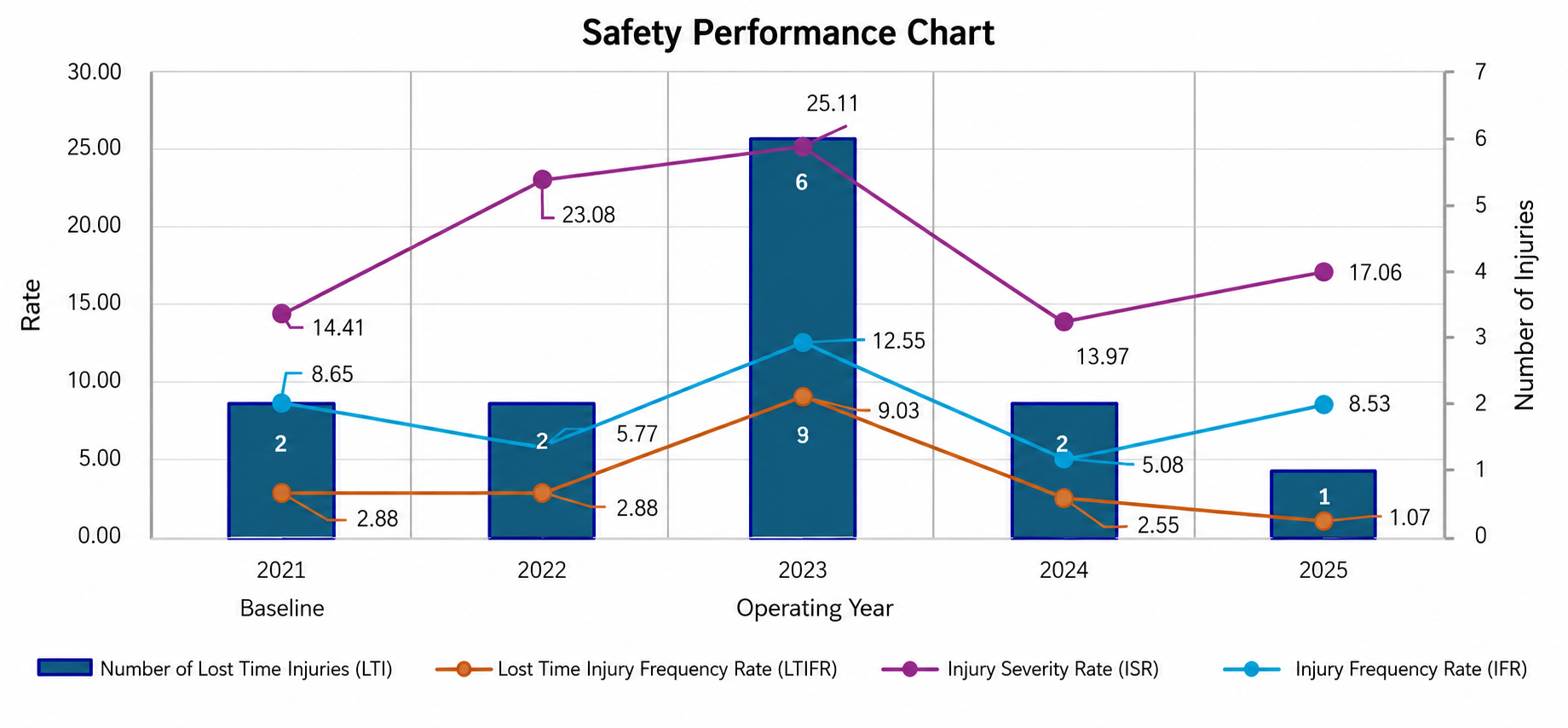
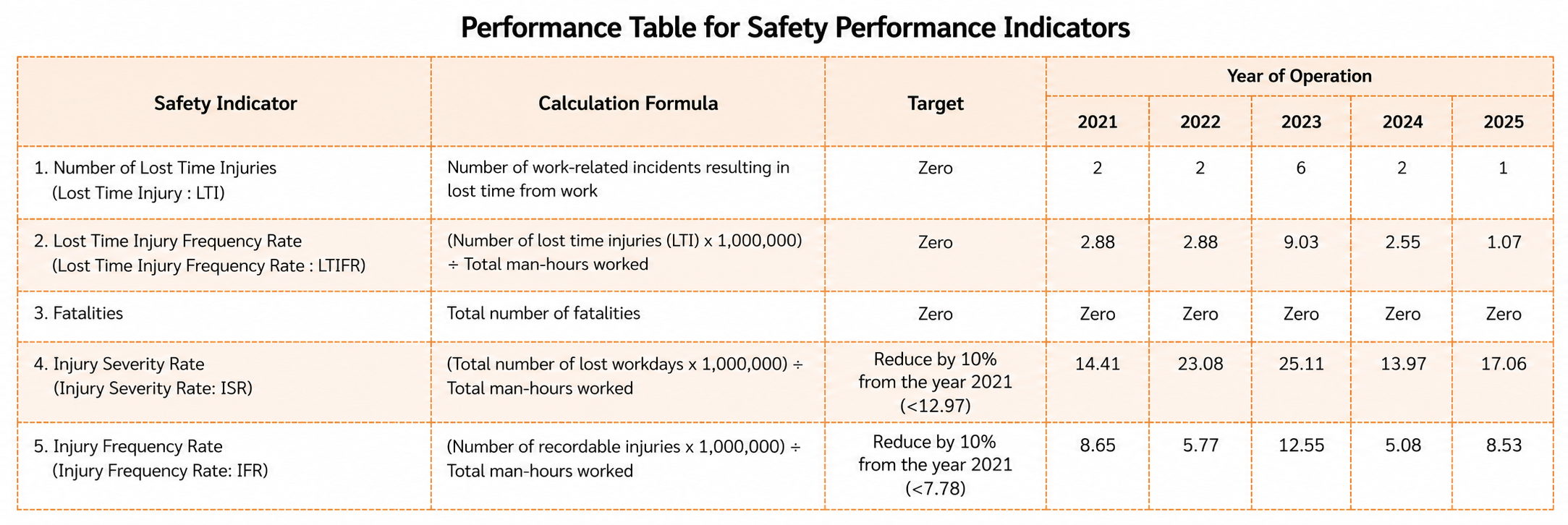
Number of Lost Time Injuries (LTI) = 0
Performance :
In 2025, LTI = 1. Target not achieved.
Target/Indicator 3 :
Lost Time Injury Frequency Rate (LTIFR) = 0
Performance :
In 2025, LTIFR = 1.07. Target not achieved.
Target/Indicator 4 :
Incident Frequency Rate (IFR) reduced by 10 percent from the 2021 baseline year (Target value <7.78)
Performance :
In 2025, IFR = 8.53. Target not achieved.
Target/Indicator 5 :
Incident Severity Rate (ISR) reduced by 10 percent from the 2021 baseline year (Target value <12.97)
Performance :
In 2025, ISR = 17.06. Target not achieved.
Target/Indicator 6 :
Number of Occupational Diseases = 0 cases
Performance :
In 2025, 0 cases. Target achieved.
Target/Indicator 7 :
Percentage of employees exposed to workplace risk factors who received health examinations according to risk factors = 100 percent
Performance :
In 2025, 100 percent of employees exposed to workplace risk factors received risk-based health examinations and follow-up. Target achieved.
Target/Indicator 8 :
Percentage of target employees receiving safety and occupational health training = 100%
Performance :
In 2025, 87.56 percent of target employees received safety training. Target not achieved.
Safety
Workplace safety is the highest priority of the organization and covers employees at all levels, including relevant stakeholders. The Company operates under the “Zero Accident” goal, placing importance on the systematic prevention of workplace accidents and losses, together with establishing clear safety indicators, such as fatal accidents, work-related accidents, and the Lost Time Injury Frequency Rate (LTIFR), to continuously monitor and evaluate performance. In addition, the Company places importance on raising employee safety awareness and promoting safe behaviors through communication, training, and participation in safety activities in order to foster a sustainable Preventive Safety Culture. Workplace safety is considered a significant organizational risk that requires close management and control.
Risk Assessment
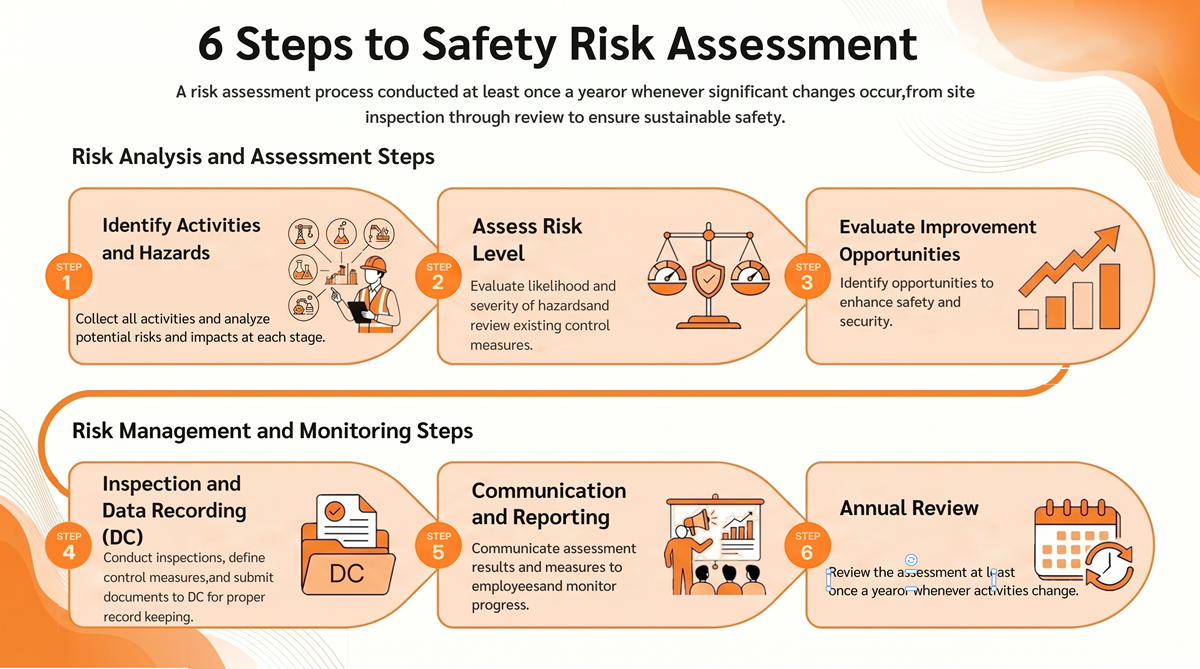
The Company requires safety, occupational health, and working environment risks to be assessed and reviewed at least once a year in order to identify significant risks and develop systematic risk control and mitigation plans. Significant safety risks identified by the Company include fire incidents, chemical spills, risks associated with the use of forklifts for lifting and transporting materials, and risks arising from unsafe behavior, negligence, or non-compliance with safety measures by employees. The Company has established appropriate preventive, control, and monitoring measures to prevent accidents and strengthen a sustainable safety culture.
Accident Investigation Process
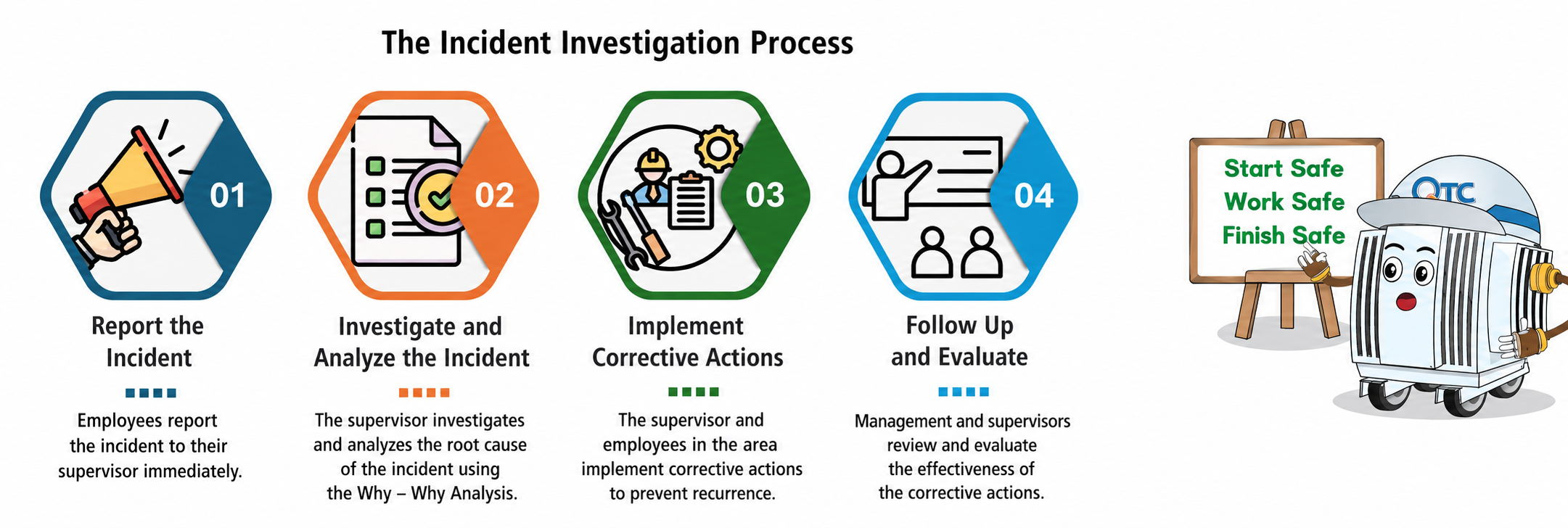
QTC Energy Public Company Limited has established a systematic process for investigating work-related accidents in order to identify the root causes of accidents, including those related to work processes, machinery, equipment, and personnel behavior. The investigation aims to establish corrective and preventive measures to prevent recurrence, as well as to use the investigation results for the continual improvement of the safety, occupational health, and working environment management system. The process is summarized as follows:
Accident Statistics
Property Damage (Cases)
Minor Injuries – No Lost Work Time (Cases)
Serious Injuries Resulting in Lost Work Time (Cases)
Total Number (Days)
Total Number (Cases)
Health
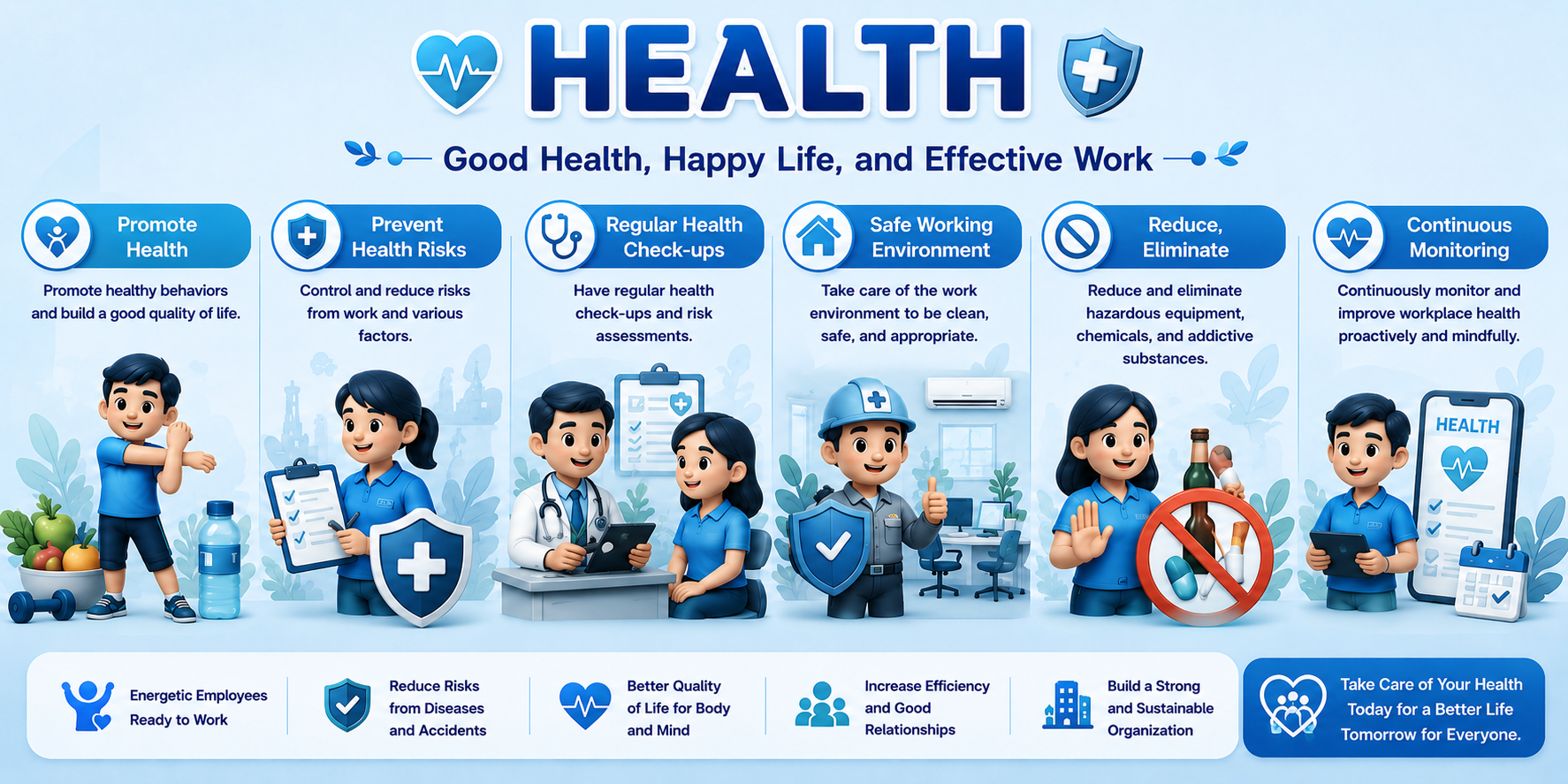
The Company places importance on promoting good employee health as a fundamental factor supporting work performance, safety, and organizational sustainability. A systematic health management approach has been established, covering health promotion, health risk prevention, and ongoing monitoring and care. The Company has adopted the Virtuous Healthy Organization Policy to promote appropriate health behaviors and create a working environment that supports the physical and mental well-being of employees, together with maintaining a pleasant, clean, and safe workplace environment. This covers lighting, noise, heat, and chemical exposure factors, as well as nutrition management and campaigns to reduce, refrain from, and quit alcohol consumption, smoking, and drug use. In addition, the Company engages occupational medicine physicians to survey and assess the working environment, job characteristics, and related risk factors in order to determine health examination programs that comply with legal requirements and include additional examinations appropriate to the age, gender, and risk levels of each employee group. Health examination results are analyzed at both the organizational and employee group levels and are used as a basis for establishing appropriate health promotion and risk prevention measures to enhance employees’ quality of life and support sustainable organizational growth.

QTC Energy Public Company Limited recognizes that human resources are a strategic factor that plays an important role in the Company’s competitiveness, business continuity, and sustainable growth. The Company places importance on workforce management as “Human Capital” that can continuously develop knowledge, skills, and value under a human resource management system that is aligned with labor laws, international standards, and sustainable development frameworks. The Company has established a human capital development approach that promotes lifelong learning, training, and the development of skills necessary for work and career advancement in order to enhance employee capabilities in line with business direction and industry changes. This is aligned with Sustainable Development Goal 4 (Quality Education) and Sustainable Development Goal 8 (Decent Work and Economic Growth). At the same time, the Company places importance on employee health, safety, and well-being in all dimensions to promote both physical and mental well-being, which are important factors contributing to labor productivity and employee engagement, in line with Sustainable Development Goal 3 (Good Health and Well-being). The Company also conducts business in accordance with the principles of respect for human rights and labor rights, promotes equality, diversity, and non-discrimination, and provides all employees with fair access to development and career advancement regardless of gender, age, or personal status. This is aligned with Sustainable Development Goal 5 (Gender Equality) and Sustainable Development Goal 16 (Peace, Justice and Strong Institutions).

Risk, Opportunity, and Impact Assessment
Risk
The organization may face risks arising from the inability to develop and retain personnel with the knowledge, capabilities, and skills required to align with business direction and industry changes, as well as risks arising from non-compliance with labor laws or inadequate employee quality of life management. Such risks may lead to labor shortages, the resignation of high-potential employees, labor disputes, and impacts on the organization’s reputation, business continuity, and long-term competitiveness.
Opportunity
Systematic human capital development, together with the promotion of quality of life, well-being, and fairness in the workplace, can enhance employee capability and productivity, strengthen employee engagement and loyalty, enable the organization to retain talented personnel, reduce employee turnover, and strengthen competitive advantage, while supporting long-term sustainable growth.
Financial materiality
+ Helps increase labor productivity, strengthen stakeholder confidence, and support the organization’s competitiveness and sustainable growth
– Violations of labor laws or human rights may result in legal risks, costs arising from penalties or labor disputes, and damage to the organization’s reputation
– The loss of knowledgeable and capable employees due to inappropriate labor management may affect operational efficiency, business continuity, and long-term financial performance
Impact materiality
+ Helps create a supportive working environment, strengthen employee engagement, and promote a quality workplace society
– Non-compliance with labor laws or human rights principles may result in discrimination, unfair treatment, violations of labor rights, and impacts on employees’ quality of life, safety, and well-being, including labor disputes
– Inadequate employee well-being management and human capital development may lead to stress, dissatisfaction, lack of motivation, workplace social issues, and employee turnover
Strategy :
- Labor and Human Rights Governance
- Human Capital Development
- Employee Health and Well-being
- Equality and Non-discrimination
- Employee Engagement and Organizational Culture
Management Approach :
Labor Management Policy, Human Resource Management Policy, Human Rights Policy, Company Regulations regarding work rules, regulations, and requirements (Employee Handbook), compliance with labor-related laws, Happy Healthy Workplace Policy, organizational implementation of Happy Workplace : Happy 8 + 1, implementation of ISO9001, ISO14001, and ISO45001 standards, together with grievance channels and investigation processes.
Labor Standards
QTC Energy Public Company Limited places importance on compliance with labor laws and fair employment practices. The Company provides compensation at no less than the minimum wage prescribed by law and offers necessary and appropriate welfare benefits to promote employees’ quality of life and well-being. In addition, the Company adheres to the principles of respect for human rights and equality in employment by providing fair recruitment and selection opportunities without discrimination based on race, religion, or gender, in accordance with the Company’s Human Resource Management Policy and Human Rights Policy.
Target/Indicator 1 :
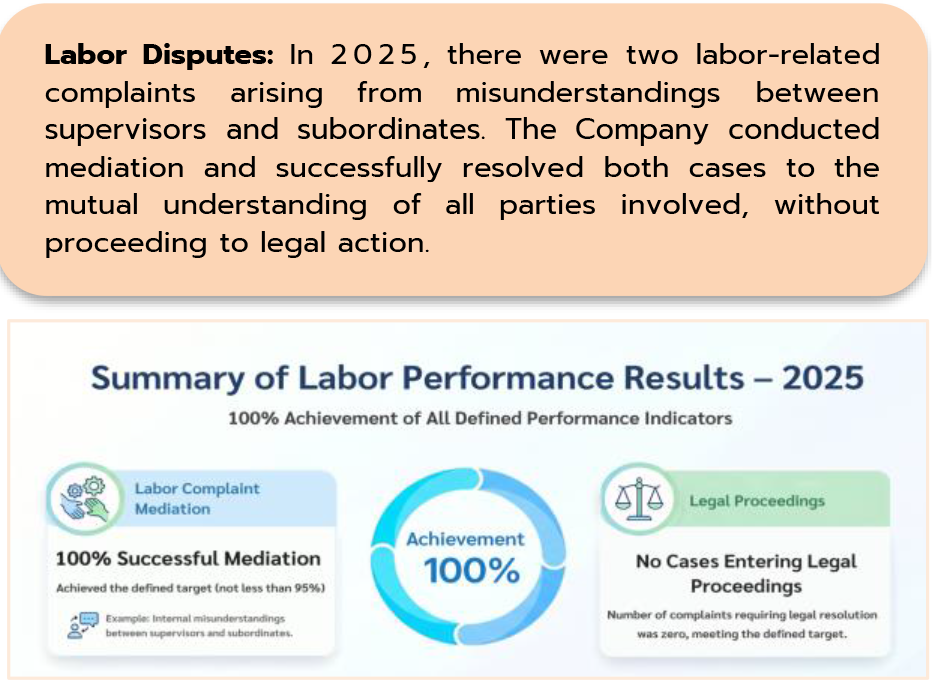
Percentage of labor complaints resolved through mediation without entering legal proceedings ≥ 95%
Performance :
In 2025, there were 2 labor complaint cases. Both cases were resolved through mediation, representing 100%. Target achieved.
Target/Indicator 2 :
Number of labor complaints entering legal proceedings = 0 cases
Performance :
In 2025, there were no labor disputes. Target achieved.
Target/Indicator 3 :
Percentage of target employees with service of 3 years or more achieving competency assessment results in accordance with the established criteria (≥ 86%) of not less than 95%
Performance :
In 2025, 90.19% of target employees with service of 3 years or more achieved assessment results of >86%. Target not achieved.
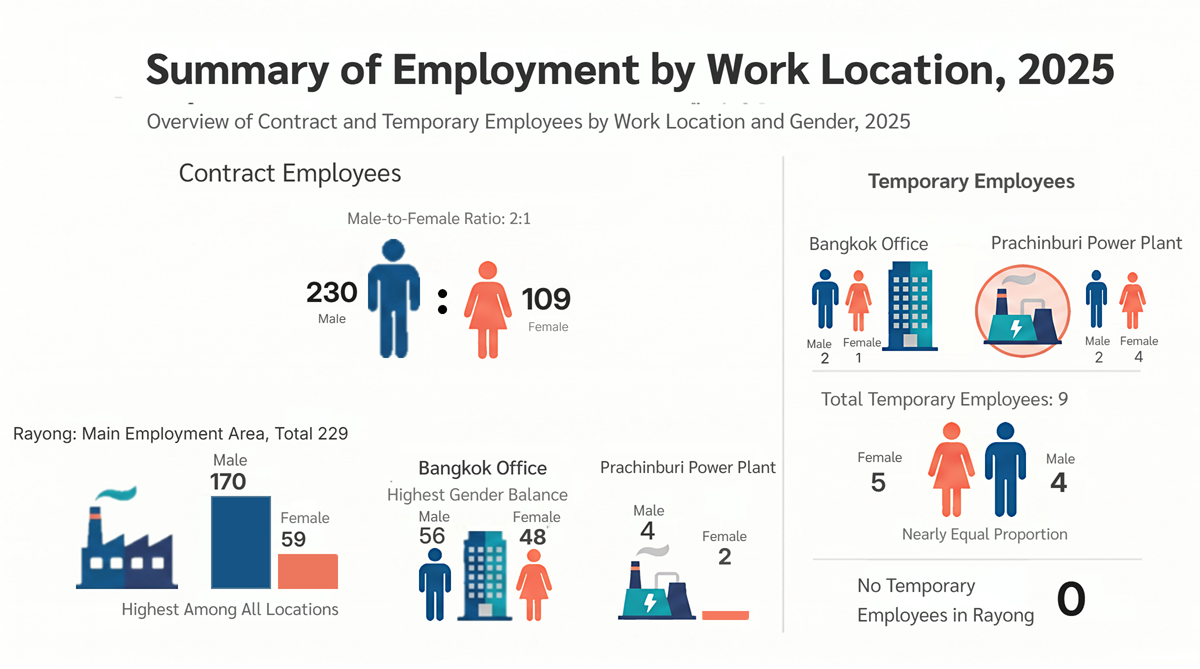
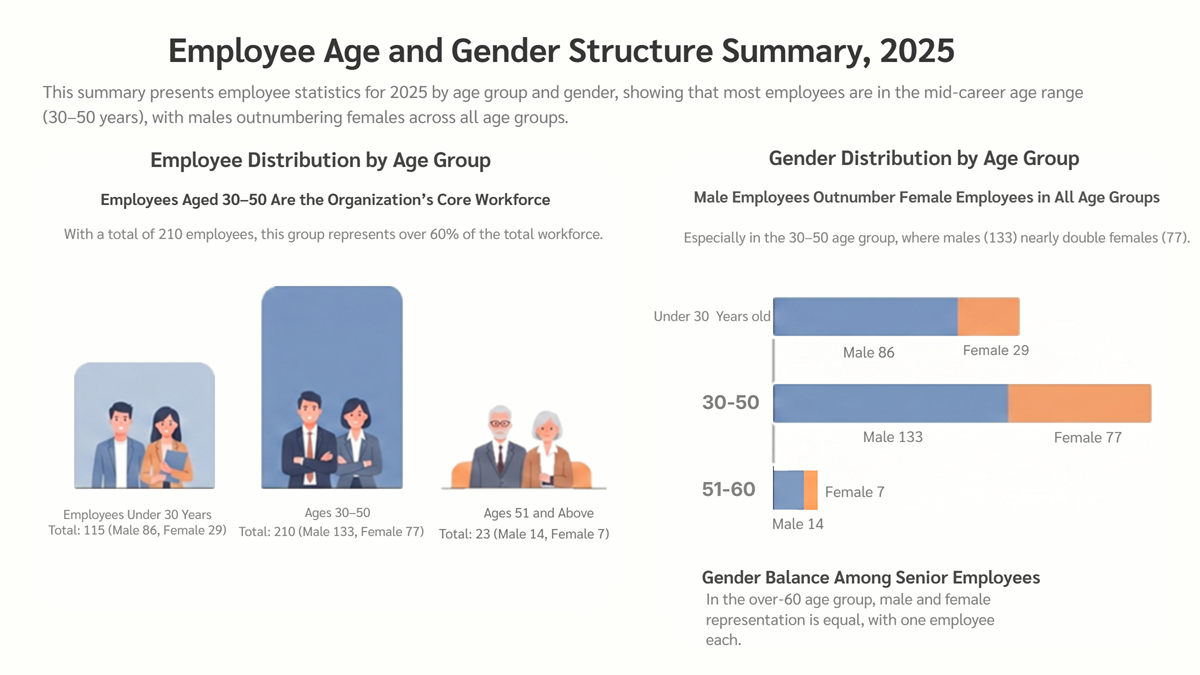
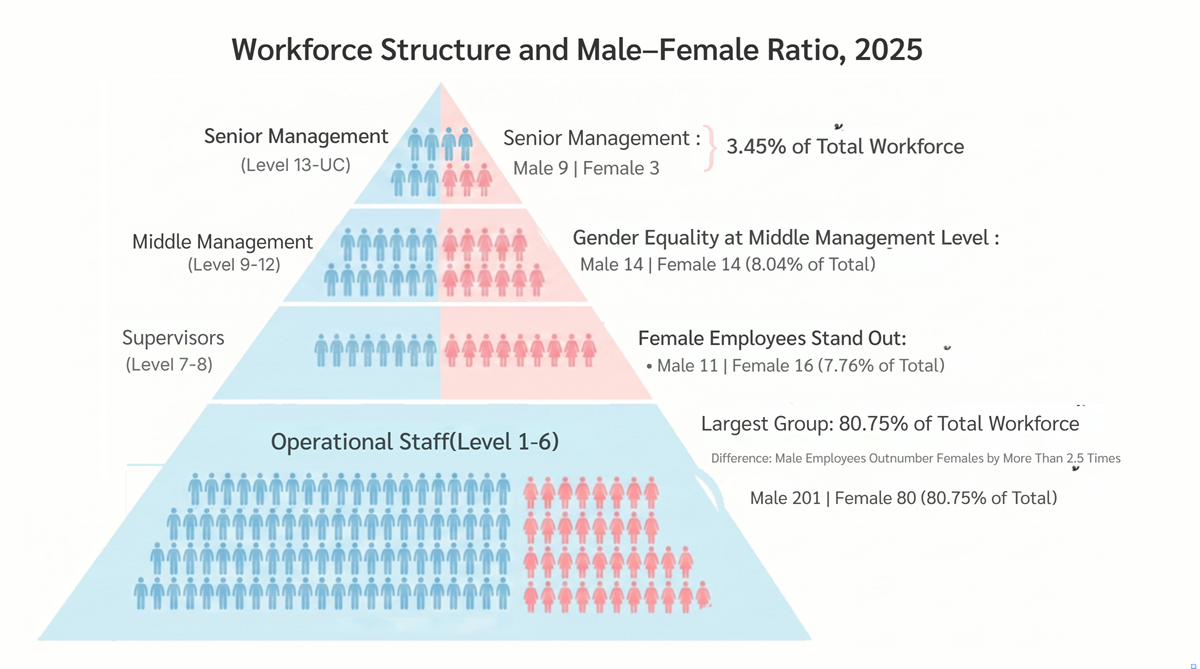
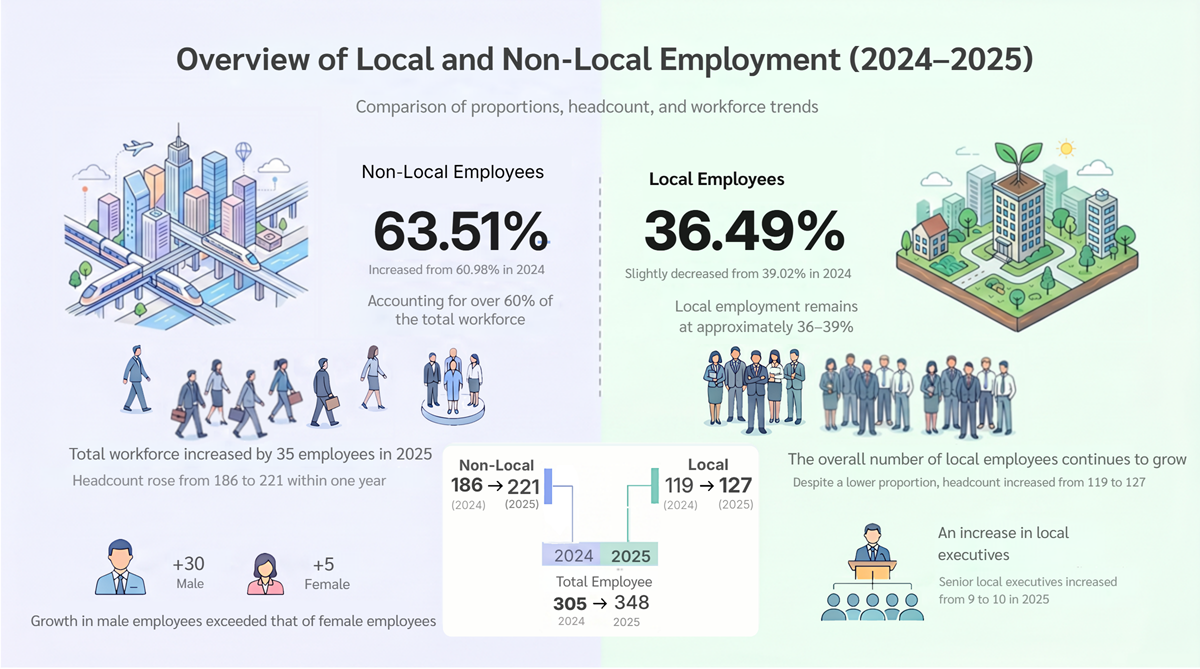
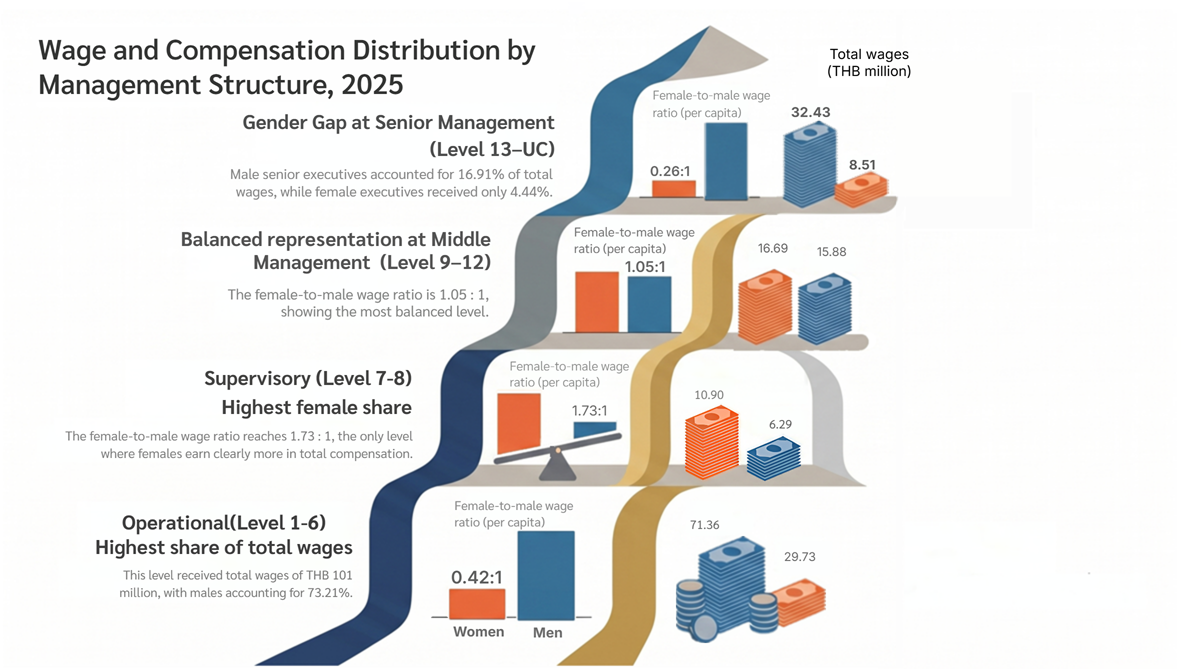
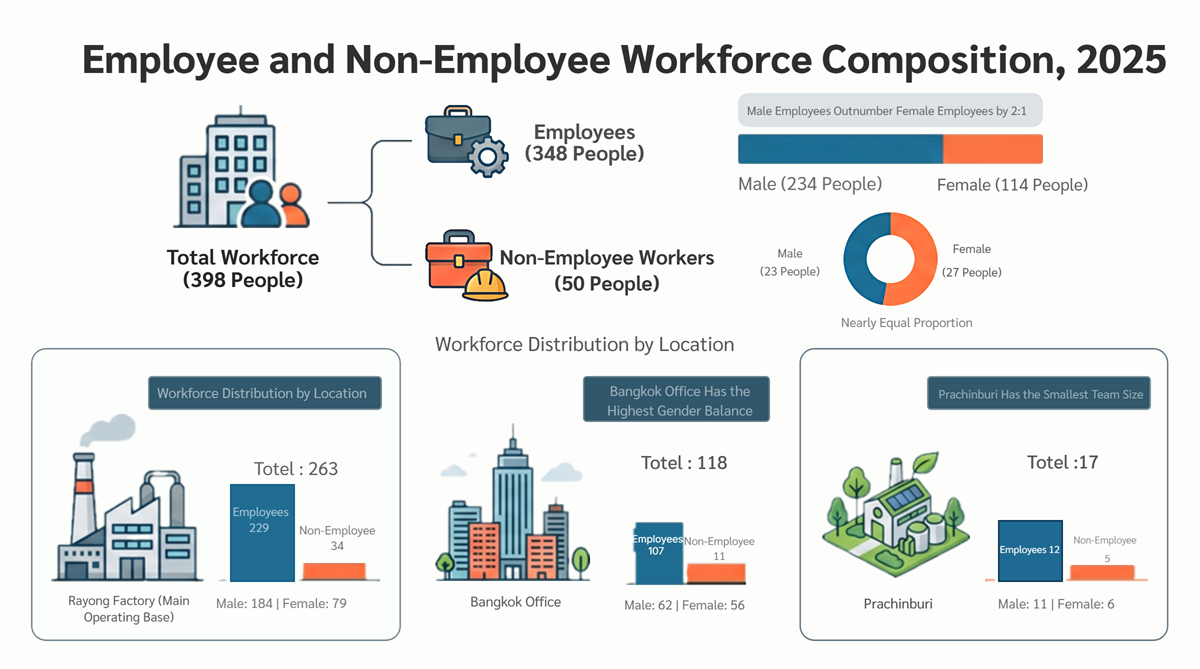
Employment Summary by Reporting Group


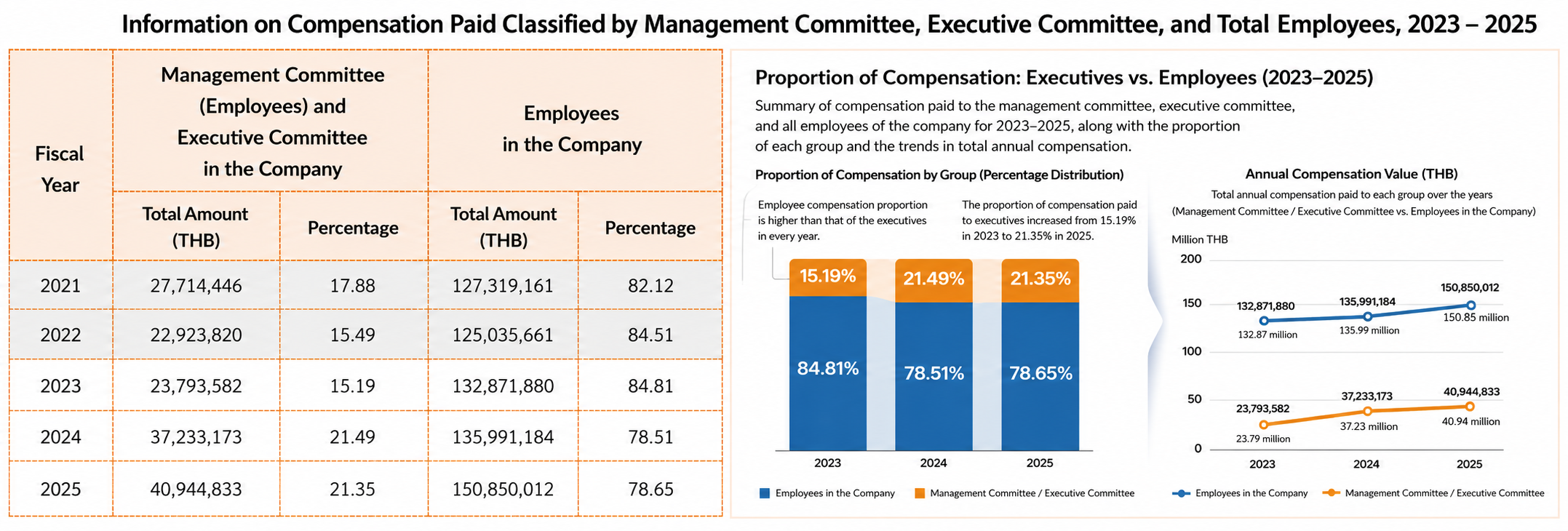
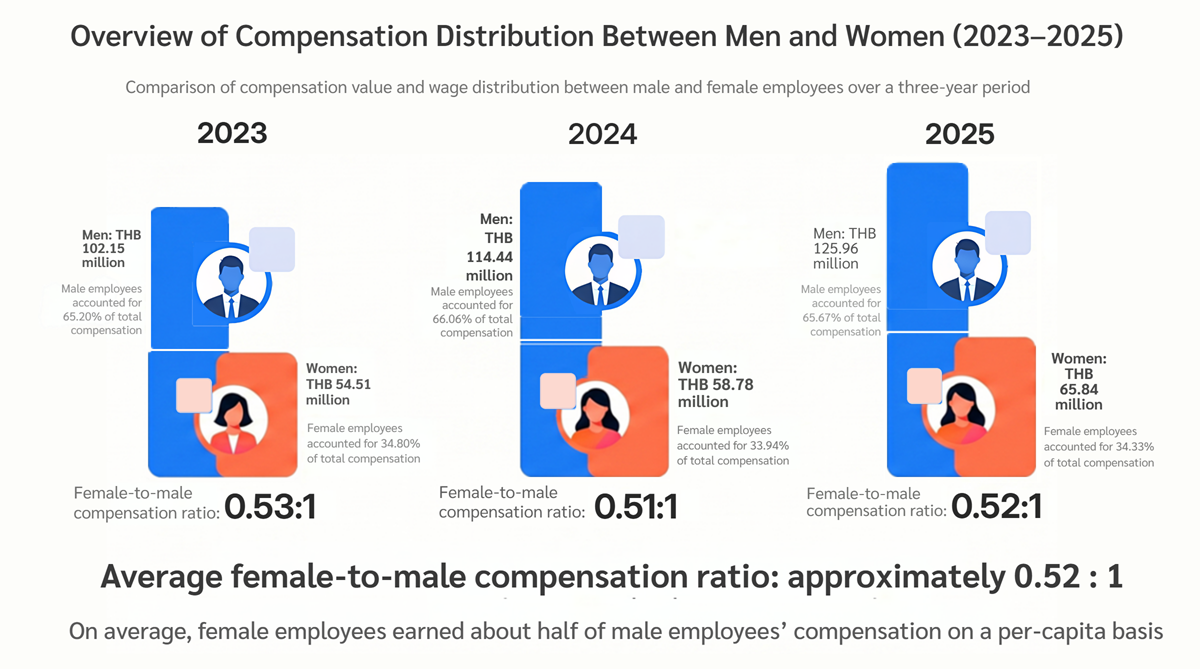
Compensation Summary


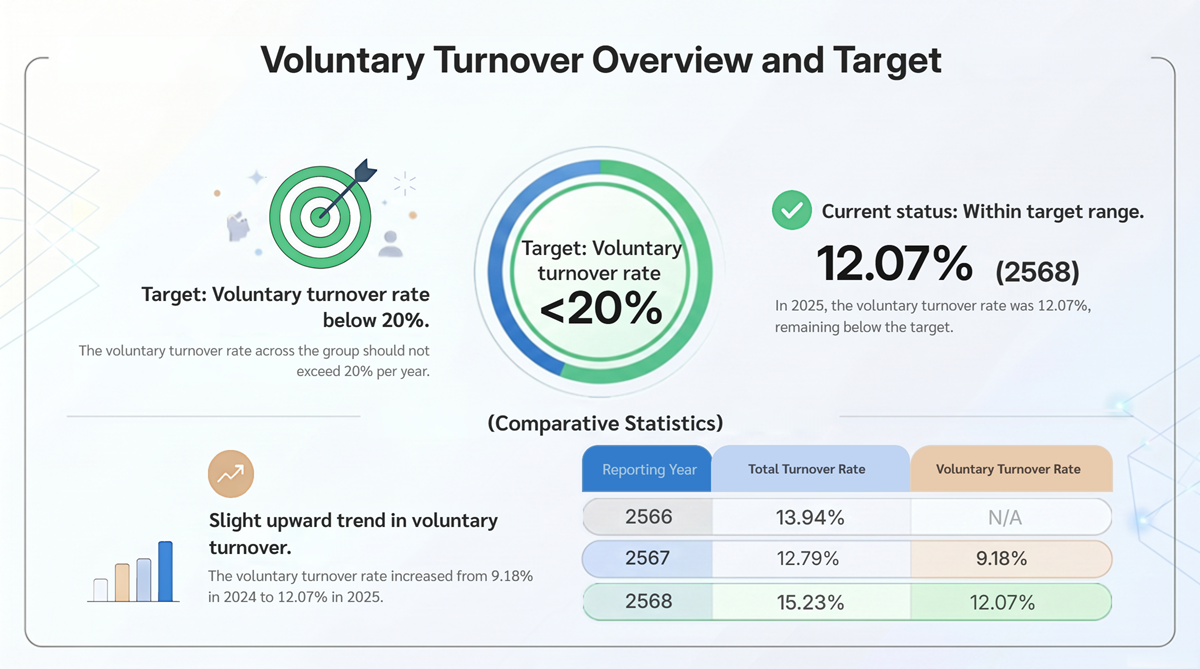
อัตราการลาออก

Human Capital
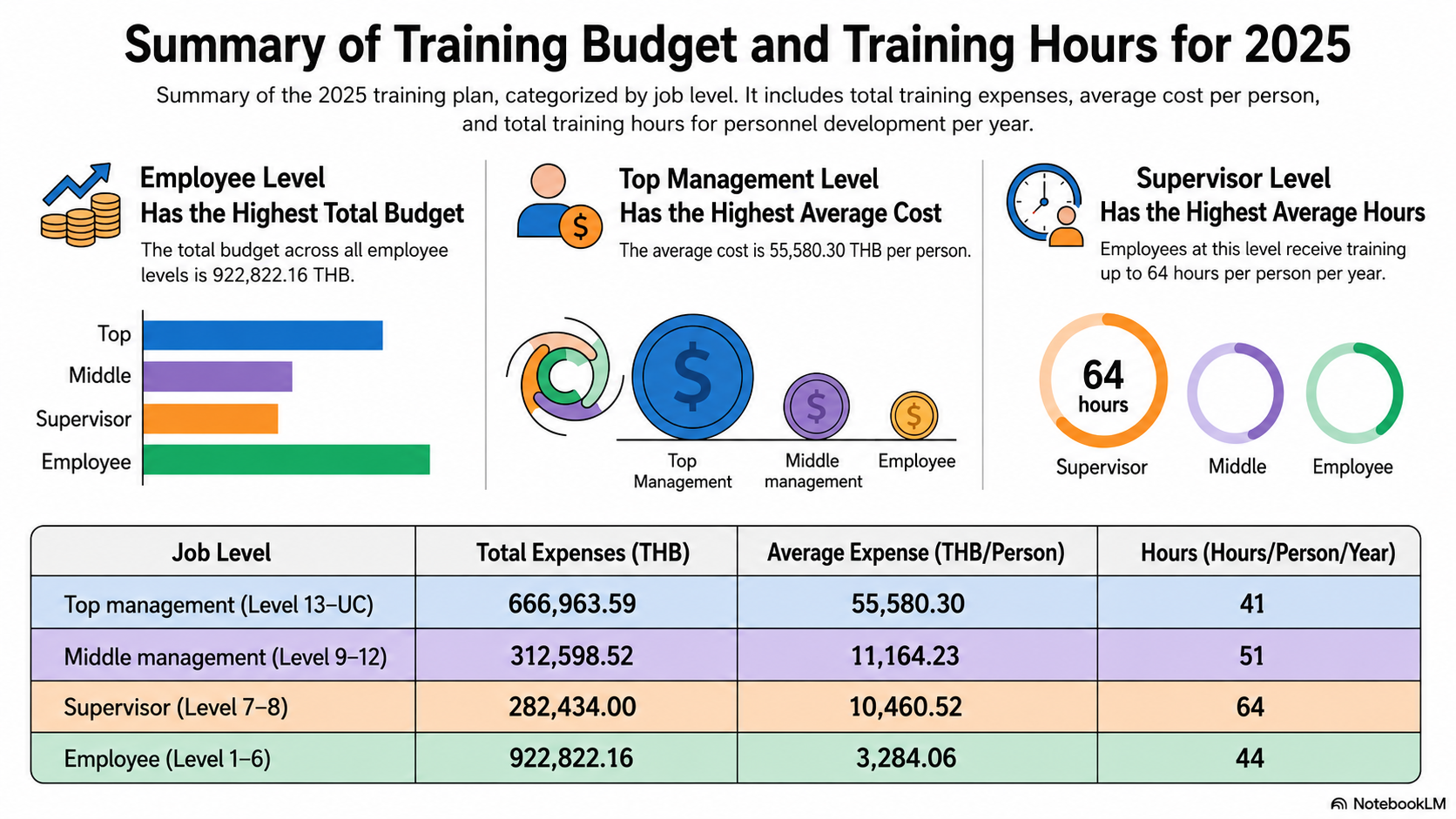
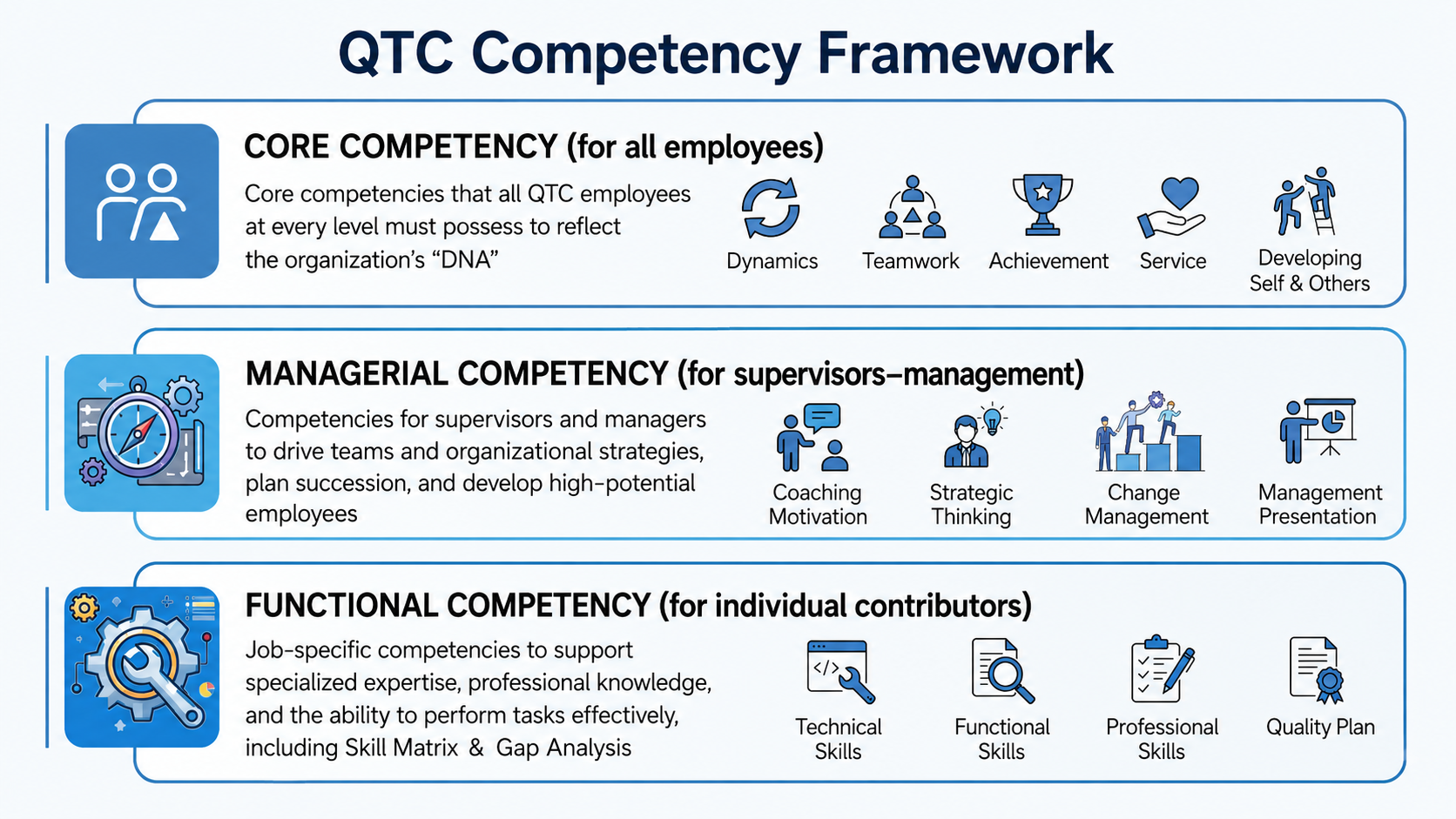
QTC Energy Public Company Limited recognizes human capital development as a strategic factor supporting the sustainable growth of the organization. The Company has established the QTC Competency Framework as a common framework for the systematic management and development of employee capabilities. The framework encompasses core competencies, managerial competencies, and functional competencies to align with employees’ roles, responsibilities, and the Company’s business direction. The Company applies the competency framework as a basis for performance evaluation, skills gap analysis, personnel development planning, and succession preparation for key positions. This approach aims to enhance employees’ capabilities to adapt to change, improve work performance, support responsible business operations, and strengthen the long-term sustainability of the Company’s human resources.
At the same time, the Company places importance on systematic knowledge management to preserve institutional knowledge, transfer critical knowledge, reduce dependency on individuals, and strengthen business continuity and good corporate governance. These efforts form an important foundation for creating shared economic, social, and environmental value and supporting the Company’s sustainable growth in the long term.
Target/Indicator 4 :
Number of knowledge management (KM) topics critical to the organization that were applied or transferred within the organization
Performance :
In 2025, 8 knowledge management (KM) topics were developed. Target achieved.
Target/Indicator 5 :
Voluntary Turnover Rate across the Group of less than 20% per year
Performance :
In 2025, the Voluntary Turnover Rate was 12.07%. Target achieved.


Well-being
QTC Energy Public Company Limited recognizes that employees are a key resource in driving the organization toward sustainable growth. The Company therefore places importance on supporting and promoting employee well-being in both work and personal life, enabling employees to maintain their own well-being and quality of life.
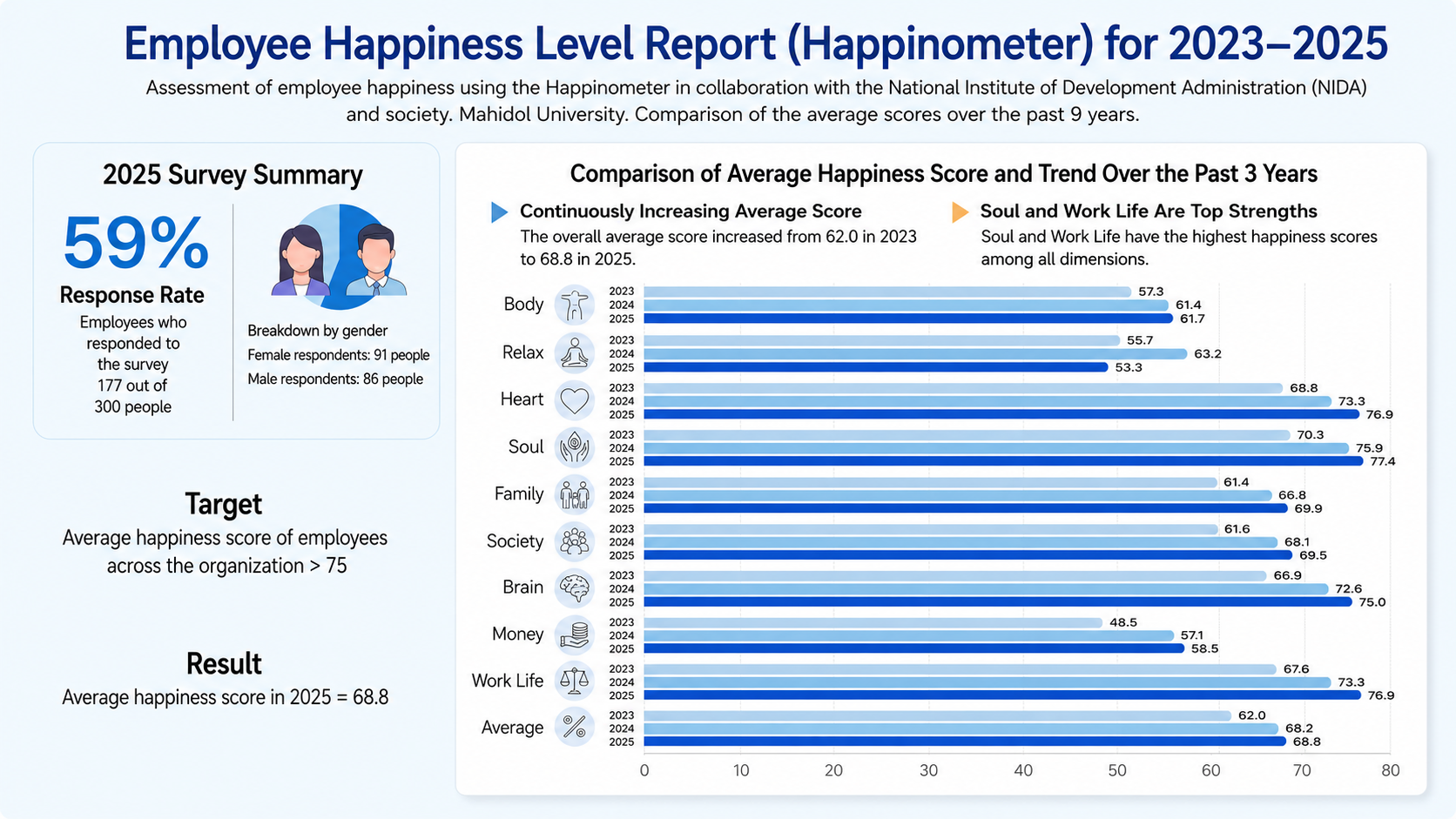
Under its Moral Well-being Organization Policy, the Company provides the necessary resources, including personnel, time, and budget, and implements various activities and programs to enhance employees’ knowledge and understanding while providing opportunities for them to participate in activities that suit their interests and needs. These initiatives contribute to sustainable happiness, work-life balance, stronger employee engagement, and long-term employee retention.
Target/Indicator 6 :
Average employee happiness index across the Group > 75 (measured using the Happinometer tool)
Performance :
In 2025, the average employee happiness index was 68.8. Target not achieved.
Target/Indicator 7 :
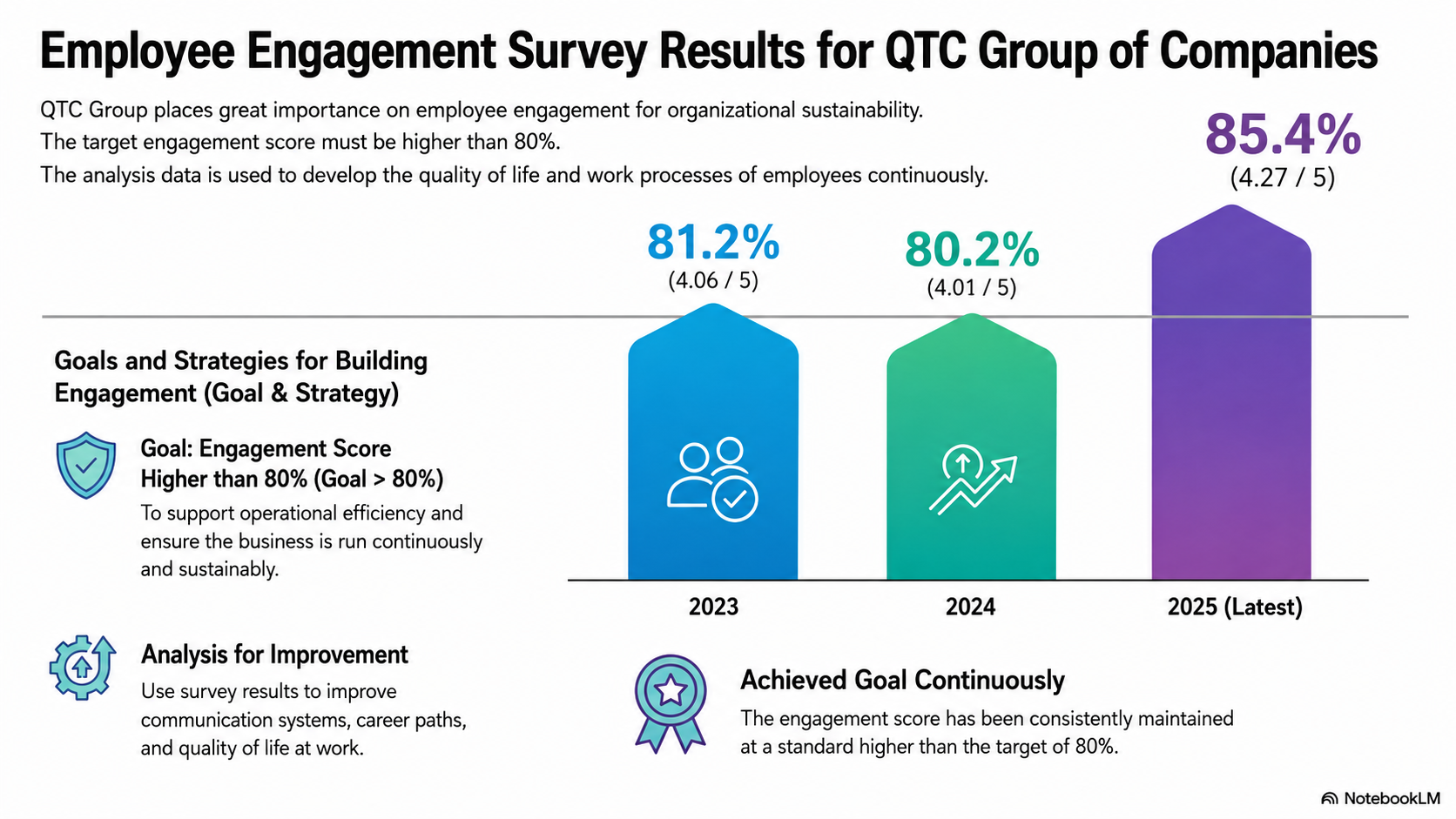
Average employee engagement score > 80 (measured through the employee engagement survey)
Performance :
In 2025, the average employee engagement score was 85.4%. Target achieved.


QTC Energy Public Company Limited is committed to respecting international human rights and children’s rights, with a focus on equality and non-discrimination. The company has integrated a comprehensive Human Rights Due Diligence (HRDD) process covering both internal operations and the entire value chain to identify, prevent, and mitigate risks that may affect employees, suppliers, and stakeholders. This approach helps create a safe working environment, promotes fair employment, and ensures transparent business practices, in alignment with the Sustainable Development Goals (SDGs), which form a key foundation for building trust and supporting the company’s sustainable long-term growth.
Risk, Opportunity, and Impact Assessment
Risk
The organization may face human rights risks arising from its operations, both within the organization and throughout the value chain, particularly in relation to discrimination, working conditions, fair compensation, safety, and the treatment of workers by business partners. In addition to directly affecting workers, these issues may also indirectly impact children’s rights, particularly those of employees’ and supply chain workers’ children, in terms of quality of life, well-being, and opportunities for development.
Without systematic management, such risks may lead to human rights and children’s rights violations, complaints, or legal issues, which may adversely affect stakeholder confidence, reputation, and long-term sustainability.
Opportunity
– Human rights or children’s rights violations may result in increased financial costs associated with remediation, penalties, legal proceedings, or the loss of long-term business opportunities.
Financial materiality
– Human rights or children’s rights violations may result in increased financial costs associated with remediation, penalties, legal proceedings, or the loss of long-term business opportunities.
Impact materiality
+ Promotes a safe, equitable, and family-supportive working environment, supporting the protection of children’s rights both within the organization and throughout the value chain.
+ Contributes to the development of a fair society, the reduction of inequality, and the promotion of the sustainable long-term growth of stakeholders.
– Unfair employment practices, such as inadequate compensation or unsuitable working conditions, may result in indirect impacts on children’s rights, particularly with respect to the well-being, safety, and development opportunities of workers’ children.
– Risks related to the treatment of workers by business partners, if not adequately managed, may lead to issues involving violations of children’s rights within the supply chain, such as child labor or environments that are unsuitable for workers’ families.
Strategy :
- Proactively manage human rights risks
- Enhance responsible supplier and supply chain standards
- Foster an organizational culture that respects rights and encourages participation
Management Approach :
Labor Management Policy, Human Resources Management Policy, Human Rights Policy, Human Rights Due Diligence (HRDD) Procedure and Human Rights Risk and Impact Assessment, Company Regulations on Rules, Regulations, and Working Conditions (Employee Handbook), Compliance with labor-related laws and regulations, QTC Supplier Code of Conduct and Guidelines, Provision of grievance channels and investigation procedures.
Target/Indicator 1 :
Percentage of employees and directly related personnel who completed training on the Human Rights Policy in accordance with the plan = 100%
Performance :
In 2025, implementation was completed as planned at 100%, achieving the target.
Target/Indicator 2 :
Percentage of activities or entities within the value chain that underwent Human Rights Due Diligence (HRDD) in accordance with the established review cycle = 100%
Performance :
In 2025, Human Rights Due Diligence (HRDD) was conducted in accordance with the review cycle and conditions established by the Company at 100%, achieving the target.
Target/Indicator 3 :
Percentage of human rights-related grievances that were investigated and closed within the specified timeframe > 95%
Performance :
In 2025, no human rights-related grievances were reported, and the target was achieved.
Target/Indicator 4 :
Percentage of labor-related measures that support families and children’s rights implemented in practice = 100% of the measures established
Performance :
In 2025, child rights-related initiatives were implemented in accordance with the established measures at 100% (3 measures), achieving the target.
Target/Indicator 5 :
Percentage of human rights risk issues identified through Human Rights Due Diligence (HRDD) that have a clearly defined risk management plan = 100% of the identified issues
Performance :
In 2025, 2 risk issues were identified involving 1 construction contractor. Discussions were conducted to jointly establish appropriate risk prevention measures, covering 100% of the identified issues, thereby achieving the target.
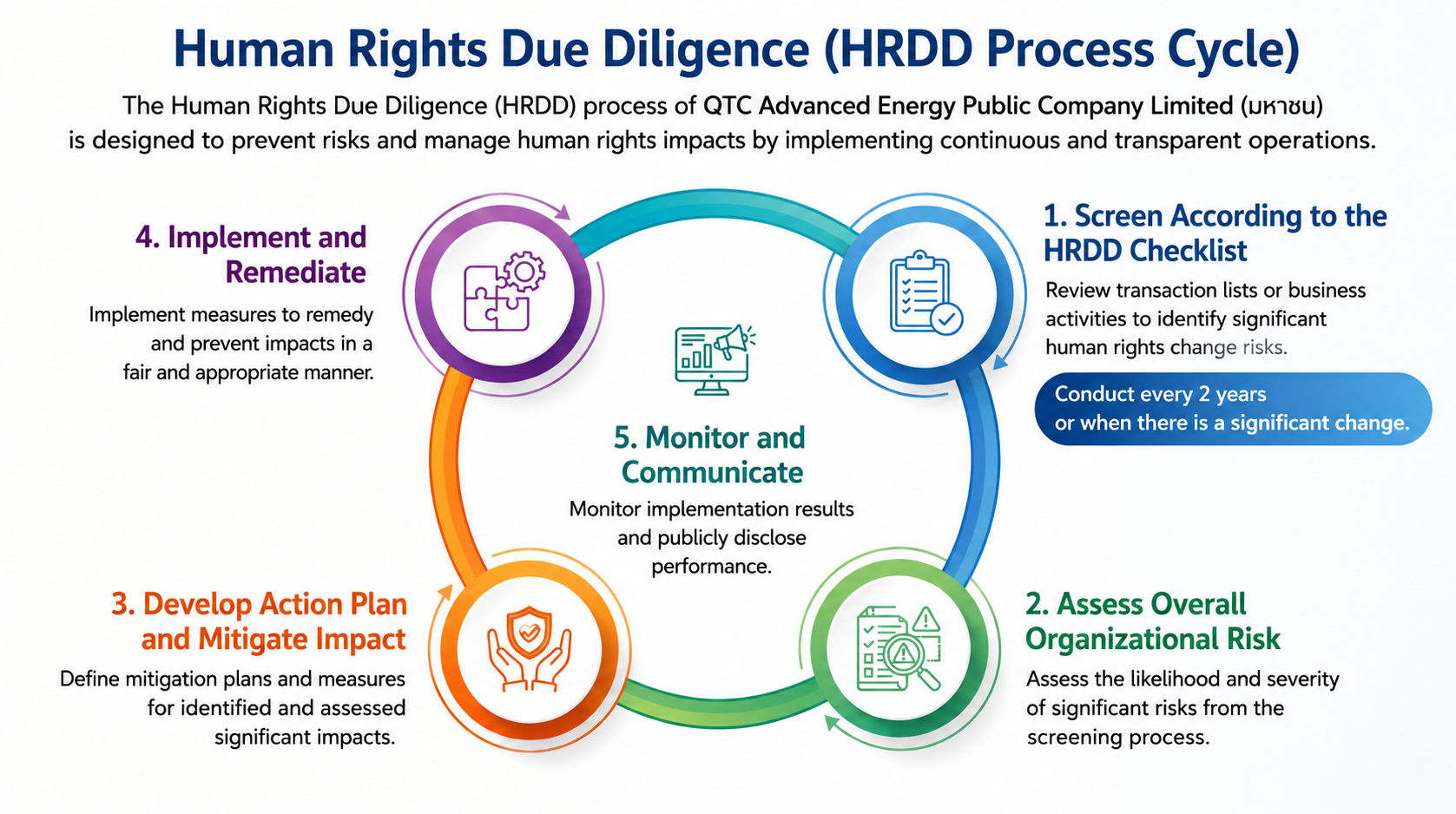
Human Rights Due Diligence: HRDD
The Company has established a Human Rights Due Diligence (HRDD) process as a mechanism to identify, prevent, and mitigate human rights risks and impacts that may arise from the Company’s business operations throughout its value chain, covering both internal operations and activities involving suppliers and business partners. The process is based on the United Nations Guiding Principles on Business and Human Rights (UNGP), the Universal Declaration of Human Rights, as well as children’s rights and business practices, with a focus on systematically respecting, protecting, and promoting human rights and children’s rights.
Human Rights Awareness Promotion
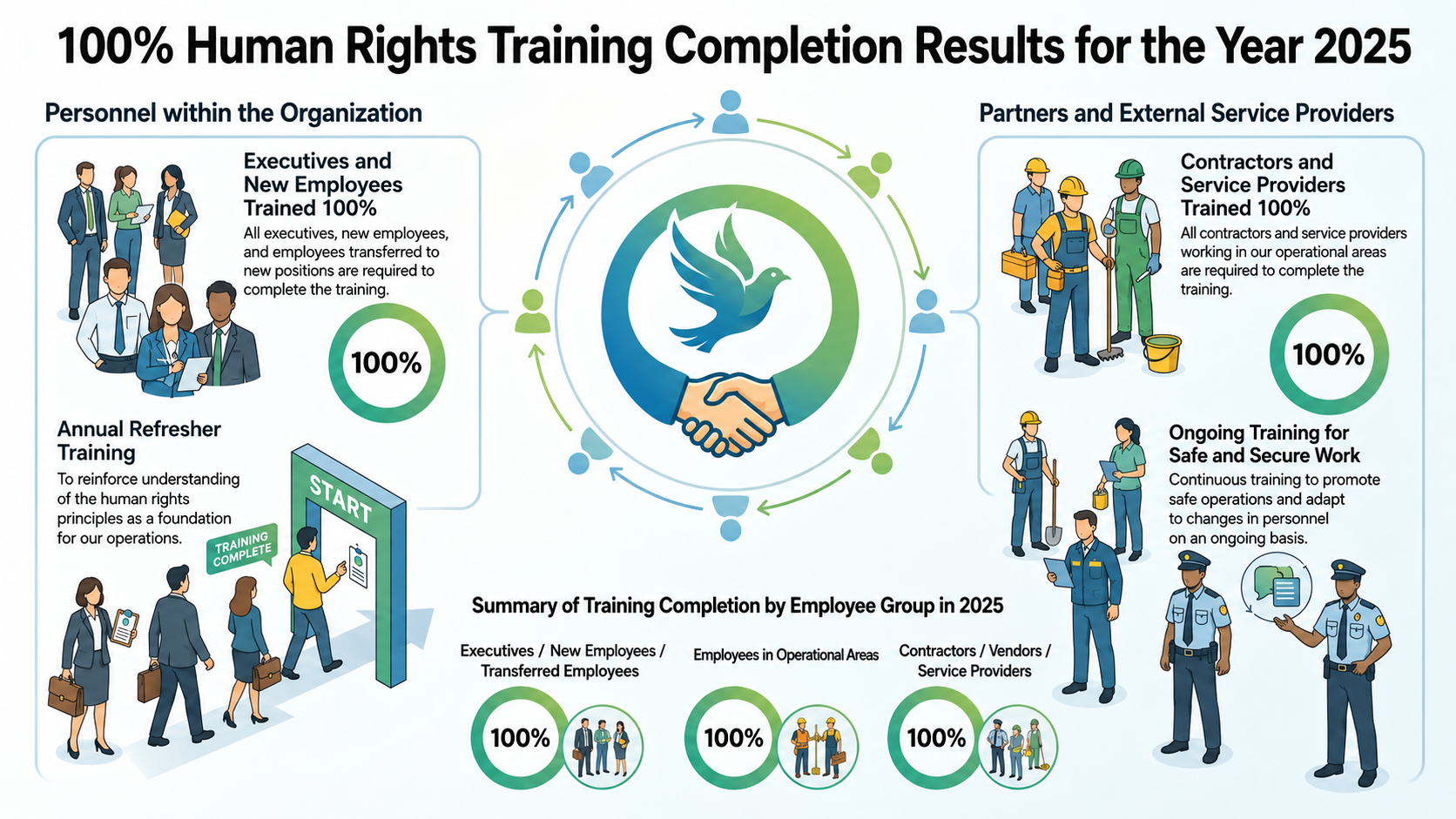
The Company places importance on promoting knowledge, understanding, and compliance with human rights principles by incorporating relevant policies, procedures, and guidelines into mandatory training programs for all positions. This is intended to ensure that all employees are aware of their rights, responsibilities, and the importance of treating others with respect and fairness.
In 2025, the Company provided human rights training to all new employees at every level and all interns, achieving 100% completion before commencement of work. Training was also provided to contractors working within the Company’s premises to promote understanding and practices consistent with the Company’s policies and standards.
Human Rights in the Organization
Welfare Committee
The Company has established a Welfare Committee elected by employees to serve as representatives of employees of the Company and all subsidiaries. The Committee is responsible for collecting and presenting employees’ opinions, suggestions, and needs regarding the improvement and development of the working environment, utilities, and welfare benefits as required by law, and submitting them to the Company in a systematic manner.
Children’s Rights in the Organization
Welfare Committee
“Breastfeeding Corner”
The Company places importance on respecting and promoting human rights, particularly children’s rights and the rights of mothers in the workplace. Accordingly, it has established a “Mother’s Corner” to support employee mothers in expressing and properly storing breast milk. This initiative promotes children’s rights to appropriate care, quality nutrition, and age-appropriate development, while also supporting employees’ rights to maintain a balance between family life and work.
“Children’s Corner”
Based on employee feedback received through the grievance and suggestion box, the Company found that employees with school-age children, particularly those with preschool and primary school-aged children, had concerns regarding childcare during school holidays and after school hours. These concerns arose from the lack of caregivers, children having to stay at home alone, or the need to enroll them in summer programs, resulting in additional expenses. In some cases, employees were required to take leave to pick up their children or send them to live with relatives in other provinces, which reduced family closeness and relationships.
“Educational Scholarships for Employee's Children”
The company places importance on promoting children’s rights to equal and continuous access to education, alongside improving the quality of life of employees’ families. The welfare committee is responsible for considering and proposing scholarships for employees’ children in accordance with specified criteria and conditions, in order to help reduce education expenses and support children’s learning opportunities from the basic level. In 2025.
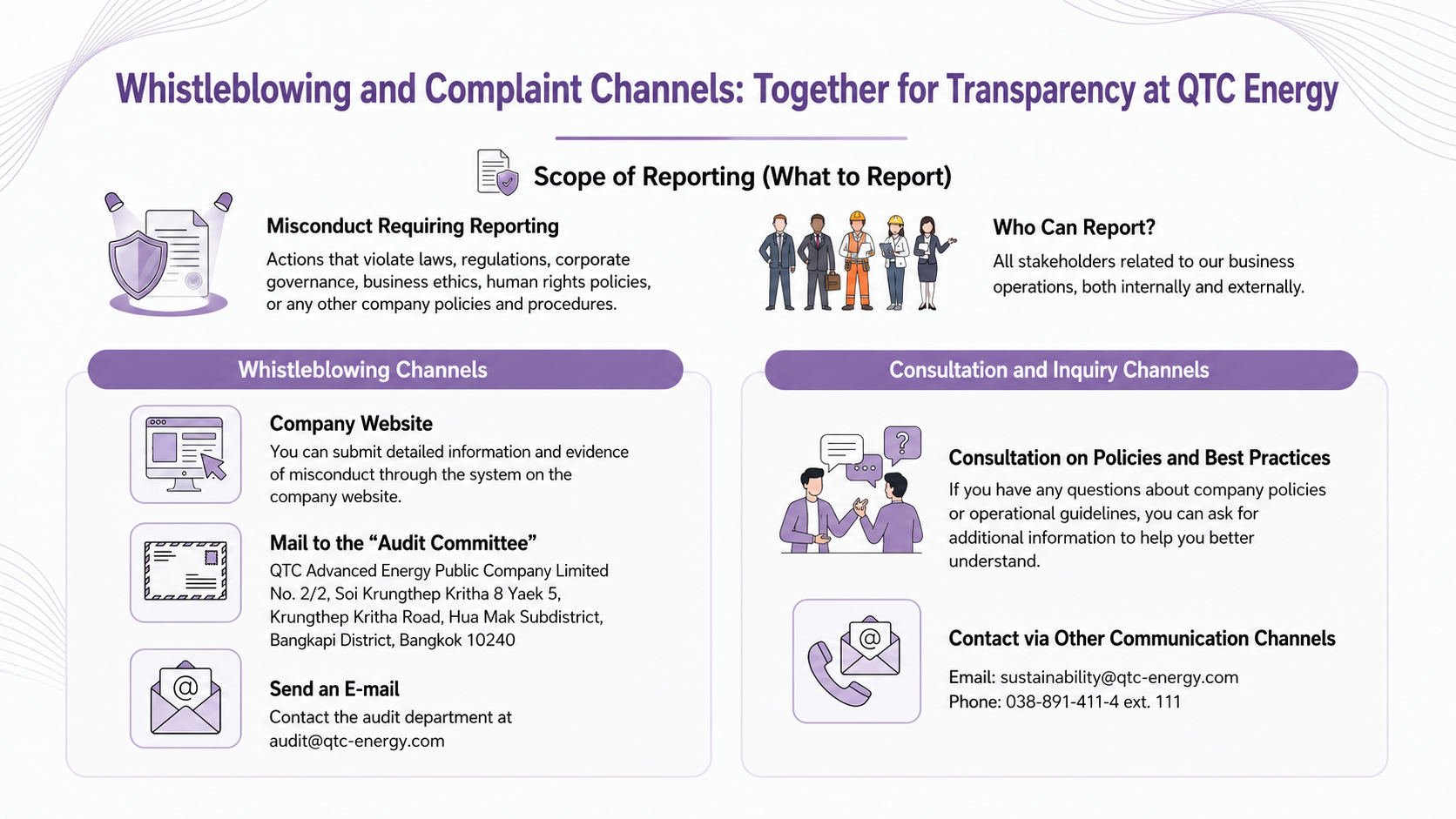
Grievance, Whistleblowing, and Complaint Channels
The Company has established systematic, transparent, and fair mechanisms and channels for grievances, whistleblowing, and complaint submissions in order to protect the rights of employees and all stakeholder groups

บริษัทฯ ให้ความสำคัญกับ การคุ้มครองผู้ร้องทุกข์และผู้ที่เกี่ยวข้อง การรักษาความลับ และการไม่ตอบโต้หรือก่อให้เกิดผลกระทบต่อผู้ร้องเรียนโดยสุจริต เพื่อสร้างสภาพแวดล้อมการทำงานที่ปลอดภัย เป็นธรรม และสอดคล้องกับหลักสิทธิมนุษยชน

QTC Energy Public Company Limited integrates the concepts of Corporate Social Responsibility (CSR) and shared value creation into its business strategy to achieve a balance in economic, social, and environmental dimensions. The company emphasizes community engagement and listening to stakeholder feedback to build trust, alongside comprehensive impact management. It also aims to enhance quality of life by generating income, supporting education, and collaborating with partner networks. These efforts align with multiple Sustainable Development Goals (SDGs), while the company remains committed to respecting human rights and equality, enabling the organization and society to grow together in a balanced and sustainable manner over the long term.

Risk, Opportunity, and Impact Assessment
Risk
If an organization fails to appropriately manage its impacts on communities and society, or does not provide opportunities for ongoing participation and communication, it may lead to misunderstanding, conflicts, or a lack of acceptance from surrounding communities. This may adversely affect stakeholder confidence and the continuity of business operations in the long term.
Opportunity
Conducting business with a systematic focus on community engagement and respect for human rights provides opportunities for the organization to develop initiatives that appropriately address the needs of local communities, strengthen trust and cooperation with stakeholders, reduce long-term conflicts, and enhance the organization’s reputation as a business that grows sustainably alongside society.
Financial materiality
+ A positive reputation for social responsibility and human rights contributes to strengthening stakeholder and investor confidence.
– Complaints or human rights issues within local communities may affect the Company’s reputation, increase the costs associated with conflict management, and adversely impact stakeholder confidence.
– Conflicts with communities or delays in development projects may affect operational plans and long-term business opportunities.
Impact materiality
+ Collaboration with local authorities, educational institutions, and network partners supports continued access to education, skills development, and economic opportunities for communities.
– If community development projects do not adequately cover all stakeholder groups or fail to comprehensively consider human rights issues, they may create perceptions of unfairness and lead to complaints or conflicts within the community.
– Inadequate communication and stakeholder engagement may result in certain community groups being unable to access information or participate equally in decision-making processes.
Strategy :
- Systematic Community Engagement
- Community Development Based on Human Rights Principles
- Creating Shared Value and Collaborative Partnerships
Management Approach :
ISO 26000 Social Responsibility Guidance Standard, ISO 14001 Environmental Management System Standard, QTC Sustainability Framework and Corporate Sustainability Policy, Human Rights Policy, Stakeholder Engagement and Comprehensive Impact Management, Collaboration with Local Authorities and Network Partners
Target/Indicator 1 :
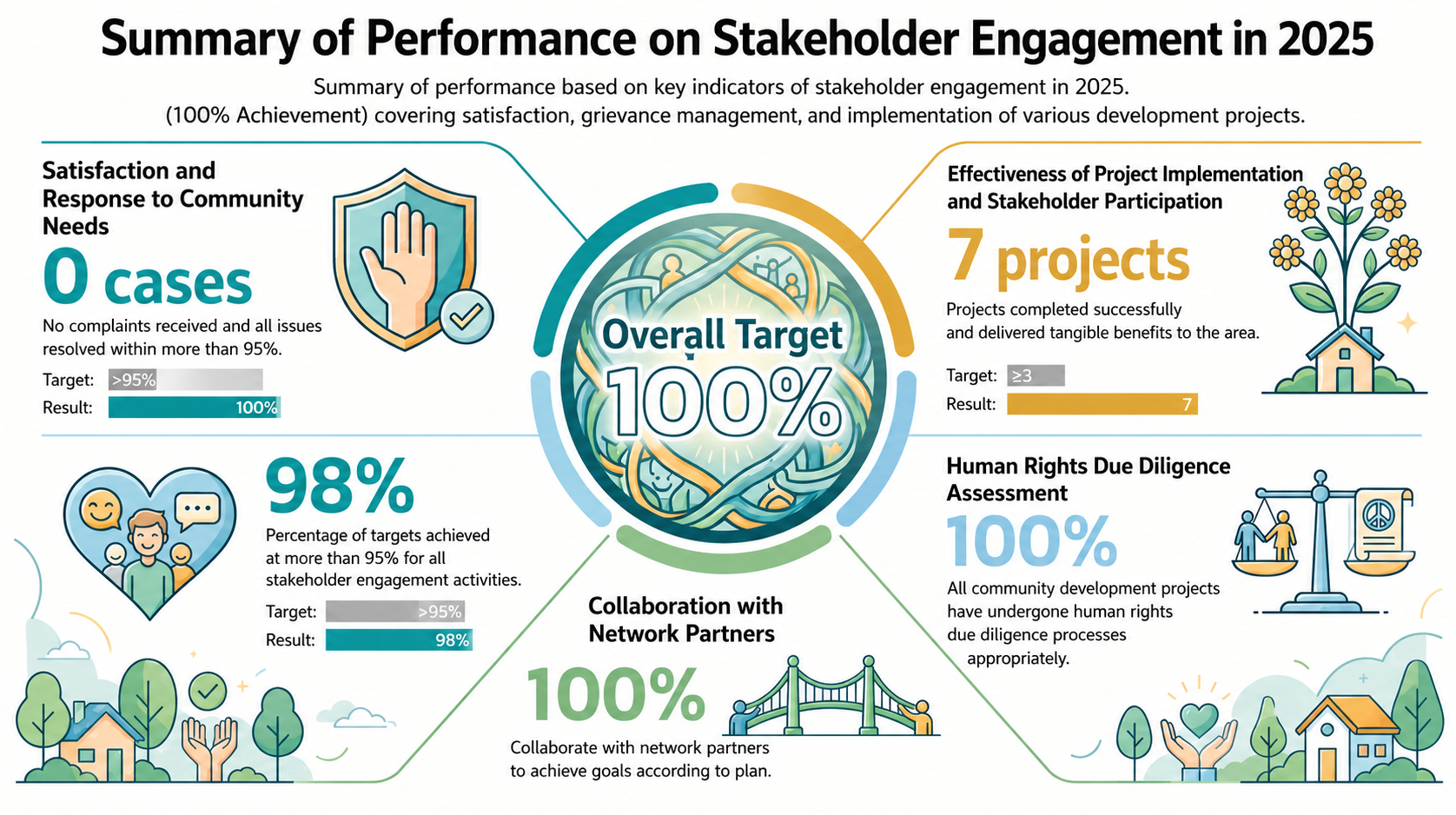
Percentage of community complaints that are responded to and managed in accordance with the established process > 95% per year
Performance :
In 2025, there were zero community complaints reported. The target was achieved.
Target/Indicator 2 :
Community satisfaction level regarding engagement and communication with the Company > 95% (replacing the Community Engagement indicator of > 98% by 2028)
Performance :
In 2025, the community satisfaction survey result was 98%. The target was achieved.
Target/Indicator 3 :
Number of community development projects that address local needs and are implemented on a continuous basis: at least 3 projects
Performance :
In 2025, 7 projects were continuously implemented. The target was achieved.
Target/Indicator 4 :
Percentage of community development activities or projects that have undergone human rights consideration = 100%
Performance :
In 2025, all 7 community development projects underwent human rights consideration, representing 100%. The target was achieved.
Target/Indicator 5 :
Percentage of collaborative projects implemented with network partners in accordance with the annual plan > 80%
Performance :
In 2025, 3 projects were included in the implementation plan, and all were completed, representing 100%. The target was achieved.

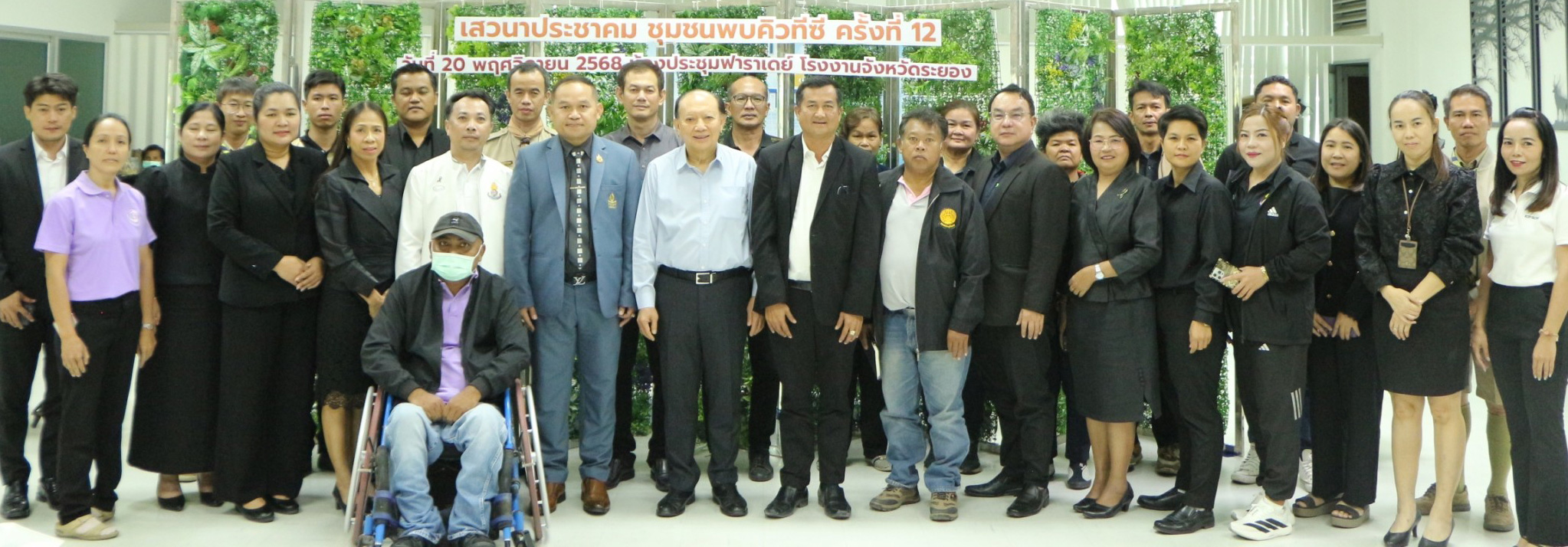
Community Forum: Community Meets QTC
QTC Energy Public Company Limited continuously organizes the community dialogue activity “Community Meets QTC” to strengthen good relationships and promote stakeholder participation across all sectors. This activity serves as an important platform for transparently communicating the company’s environmental, social, and governance operations, while providing opportunities for community representatives and partner networks to exchange views, reflect concerns, and propose ideas for community development.
This implementation reflects the company’s commitment to developing the organization alongside the community in a sustainable manner, with emphasis on listening to stakeholders’ voices and using their feedback as input for planning and developing concrete operational approaches that truly respond to the context and needs of the area.
Community and Social Development Participation

Science and Technology Camp Project
The company aims to promote participation in community and social development through collaboration with government agencies, educational institutions, community organizations, and partner networks, in order to sustainably improve quality of life, education, careers, and the local economy alongside the company’s growth.
Educational Workforce Development Project
The company supports the development of the educational workforce to prepare personnel with skills and experience that align with the needs of future industries.
“Promoting and Enhancing the Quality of Life of Persons with Disabilities” Project
The company implements projects to promote and improve the quality of life of persons with disabilities in Thailand, aiming to create career opportunities, develop skills, and support sustainable self-reliance, while reducing inequality and fostering an inclusive society.
Social Procurement Project to Support Persons with Disabilities
The company implements procurement initiatives to support persons with disabilities and community enterprises by promoting employment, generating income, and improving the quality of life of persons with disabilities in a sustainable manner through a Social Procurement approach.
“Together for Our Hometowns” Project
The company implements the “United for Local Communities” project to promote employee participation in community development through CSR activities that address local needs and support sustainable improvement in quality of life.
Project on Transforming Waste Materials into Educational Opportunities
The company implements the “Turning Waste Materials into Educational Opportunities” project by utilizing materials from its operations to support learning, develop vocational skills, and generate sustainable income for students and local communities.
Transformer Donation Project for Community Electrical Infrastructure Development
The company supports the provision of transformers to develop electrical systems in communities, educational institutions, and healthcare facilities, aiming to enhance quality of life and infrastructure through continuous engagement and responsiveness to community needs.
Social Activities
The company conducts social activities in various forms to promote quality of life, well-being, and community resilience, through employee participation and appropriate resource support for sustainable coexistence.
Voices from Community and Social Representatives
Positive feedback from the community reflects the outcomes of the company’s operations in effectively addressing local needs, particularly through the provision of essential resources and improvements in quality of life, resulting in trust and acceptance of sustainable community development.


QTC Energy Public Company Limited places importance on customer responsibility as a key mechanism for ensuring the reliability of energy infrastructure, the safety of users, and the confidence of stakeholders. The Company manages the design and manufacturing processes of transformers in accordance with relevant standards and considers safety throughout the product life cycle in order to prevent risks to the health and safety of users and surrounding communities, in alignment with SDG 3: Good Health and Well-being and SDG 9: Industry, Innovation and Infrastructure.
The Company emphasizes the quality, accuracy, and reliability of its products and services by providing clear, transparent, and non-misleading information on product characteristics and technical specifications, together with appropriate protection of customer information and confidentiality. This approach supports responsible production and consumption in alignment with SDG 12: Responsible Consumption and Production.
Risk, Opportunity, and Impact Assessment
Risk
If the design, manufacturing, or provision of product and service information does not comply with applicable standards, it may create safety risks for users and lead to impacts on customers’ operations, including complaints or legal disputes. In addition, incomplete or inaccurate communication and inappropriate management of customer information may affect customer confidence, brand image, and long-term customer relationships.
Opportunity
Conducting business with responsibility toward customers through continuous improvement of quality, safety, and transparent communication helps strengthen customer confidence and satisfaction, supporting customer retention and long-term business opportunities. Furthermore, customer feedback supports the development of products and services that better respond to market needs.
Financial materiality
+ Customer confidence and satisfaction support customer retention, repeat orders, and long-term market expansion opportunities.
+ A positive corporate image in customer responsibility supports competitiveness and sustainable brand value creation.
– Deficiencies in design, manufacturing, or inaccurate information may result in additional costs for corrective actions, legal disputes, or compensation.
– Ineffective complaint management may result in customer loss and affect revenue and operating performance.
– Reputational damage arising from quality or safety issues may reduce brand credibility and business partner confidence.
Impact materiality
+ Providing accurate, clear, and transparent technical information supports the proper and safe use of products by customers.
+ Receiving customer feedback and complaints supports the development of products and services that better meet user needs.
– Products or services that lack quality or fail to meet standards may create safety risks affecting the lives and property of users.
– Incomplete or inaccurate communication may create misunderstandings and affect customer decision-making.
– Inappropriate protection of customer information and confidentiality may affect customer rights and stakeholder confidence.
Strategy :
Management Approach :
The Company manages its operations through internationally recognized standards (International Organization for Standardization) and Total Quality Management (TQM). Product design, manufacturing, and testing are conducted in accordance with product standards and customer requirements, including ISO 9001 and ISO/IEC 17025 standards. Customer relationship management is implemented to enhance customer awareness and engagement, while customer satisfaction surveys are conducted and used for continuous improvement.
Target 1
Number of incidents causing harm to users due to products not meeting quality standards: Zero cases (no incidents).
Performance :
In 2025, no such incidents were reported. Target achieved.
Target 2
Customer satisfaction score of not less than 90%.
Performance :
ปี 2568 ระดับความพึงพอใจลูกค้าร้อยละ 92 บรรลุเป้าหมาย
Target 3
In 2025, customer satisfaction reached 92%. Target achieved.
Performance :
In 2025, 100% of customer complaints were resolved and closed. Target achieved.
Target 4
Percentage of transformer inspection and maintenance services performed within the warranty period in accordance with specified conditions: not less than 90%.
Performance :
In 2025, the Company achieved 98%. Target achieved.
Target 5
Number of customer personal data breach incidents: Zero cases (no incidents).
Performance :
In 2025, no reported incidents of customer data leakage occurred. Target achieved.
Operational Standards
The company applies international standards to its operations to enhance quality, credibility, and competitiveness at both the national and international levels.
Provide your feedback on BizChat
Product Standards
The company designs, manufactures, and tests transformers in accordance with international standards and relevant industrial standards to ensure product quality, safety, and reliability for both domestic and international markets.
Electrical Testing Standards
The company conducts testing of every transformer in accordance with international standards under an ISO/IEC 17025 accredited testing laboratory to ensure quality, safety, and transparency for customers.
Customer Care
The Company places the highest importance on establishing and maintaining strong customer relationships by responding to customer needs, listening to feedback, and systematically addressing issues related to products and services. Customer feedback and concerns are collected through complaint management channels and customer satisfaction surveys and are analyzed to support continuous improvement and operational development. The Company also emphasizes transparent communication and marketing practices by providing accurate, complete, and verifiable technical information through appropriate communication channels, including the Line Official Account, Facebook, product catalogues, and other marketing media. Educational seminars on products and technologies are also organized, with due consideration given to personal data protection and customer confidentiality.
Customer Performance Measurement for 2025
Customer Satisfaction
The company continuously monitors and evaluates customer satisfaction in order to improve the quality of its products and services to effectively meet customer needs. In 2025, the customer satisfaction level was 92%.
After-Sales Customer Care
The company places importance on after-sales customer care by focusing on the inspection and maintenance of transformers to ensure quality, safety, and continuous operational efficiency.
Customer Complaint Management
The company places importance on effective management of customer complaints by focusing on prompt, transparent resolution and preventing recurrence, in order to continuously build customer confidence and satisfaction.